

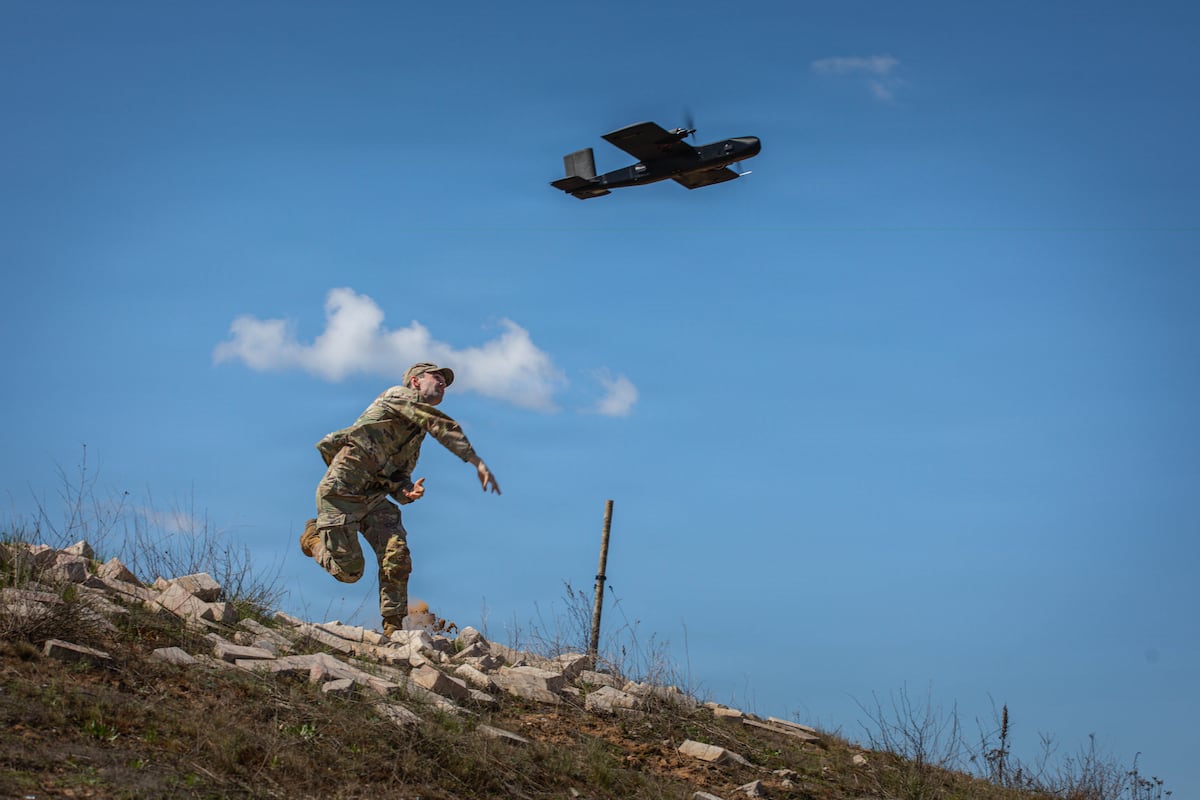
As the U.S. Army trains soldiers for multi-domain operations, like in the multinational exercise Project Flytrap, the service needs to prepare them with “new basics” to establish one standard and baseline, officials said.
Within the 2nd Cavalry Regiment, or 2CR, new basics include unmanned aerial systems operation and employment, counter-UAS systems and unmanned ground vehicle usage, service officials said during a Monday discussion at the Association of the U.S. Army annual meeting, titled “Project Flytrap—Accelerating Offensive Maneuver through Data-Centric Kill Web.”
Project Flytrap is an Army counter-unmanned aerial systems initiative and multinational exercise, which has leveled up from the individual soldier to the squadron level with multiple iterations.
The most recent exercise, Project Flytrap 5.0, took place in Lithuania and was concluded earlier this year with partner nations, including the United Kingdom and Australia, and was led by the Army’s V Corps. The countries integrated and tested more than 50 industry-provided technologies, launched effects and unmanned ground vehicles and tested against a live opposing force.
“The American way of war is centered on maneuver, and counter-UAS cannot remain tied to static defense,” Col. Timothy Price, commander of the 2nd Cavalry Regiment, said in a Tuesday release. “Project FlyTrap ensures we maintain mobility and offensive survivability in a highly contested, opaque operational environment.”
The 2nd Cavalry Regiment is expanding Project Flytrap into a battalion-level operational capability, adapting from small-unit field trials into tactical employment connected with operational objectives aimed at breaking through drone-saturated frontlines on Europe’s Eastern Flank.
“As we’re training our soldiers for the multi-domain operations, or multi-domain breeds, we talk about the new basics inside of 2CR,” Command Sgt. Maj. Jesse Clark, 2nd Cavalry Regiment senior enlisted leader, said during Monday’s discussion.
“With the new basics, we need to focus on sUAS, counter-UAS, camouflage for electromagnetic signatures … and how we’re going to do that so soldiers understand how to camouflage themselves with those spectrum options,” he continued.
Officials listed the previous basics to include topics such as marksmanship, map reading and navigation, radio etiquette and UAS and jamming reaction to contact.
Clark said the service needs to have disciplined unit training management in which personnel, time and equipment are included to ensure soldiers are proficient at the new basics. One way to complete this is to have a series of expert badges.
“Everyone needs to know these basics because it’s going to be required whether you’re on the frontline or you’re back in the rear because we’re going to have UAS all over the place,” Clark said.
The U.S. military has strived to incorporate UAS and counter-UAS training across all branches, with new units in the Marine Corps and the Defense Innovation Unit aiming to recruit service members with first-person-view drone experience to participate in the Pentagon’s Drone Dominance program.
Cristina Stassis is a reporter covering stories surrounding the defense industry, national security, military/veteran affairs and more. She previously worked as an editorial fellow for Defense News in 2024 where she assisted the newsroom in breaking news across Sightline Media Group.
Read the full article here