

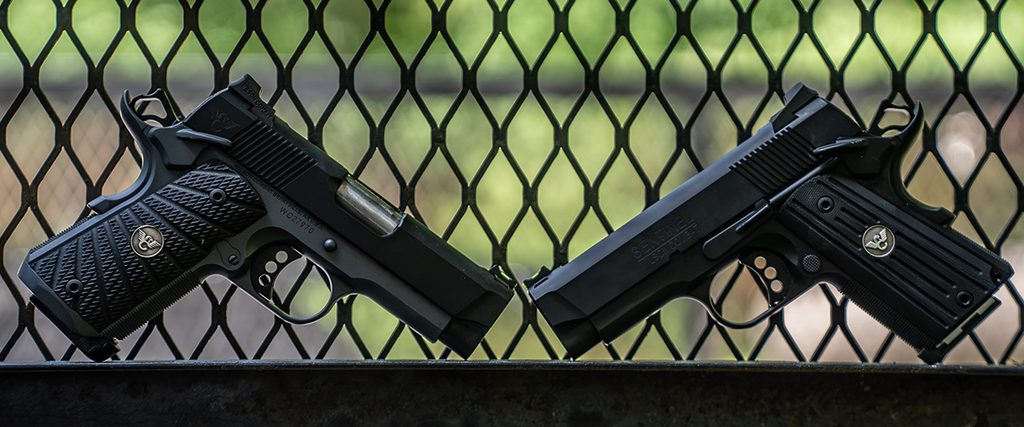
I hit the range to put Wilson Combat’s compact Sentinel pistols to the test.
Duty-sized high-capacity double-stacked 9mm pistols with dot sights have been all the rage as of late. Wilson Combat has fed this frenzied demand with excellent pistols like their P1, Experior Elite, and their newest pistol—the revolutionary Bulwark. All are great guns, but they are all also on the large side for everyday carry. I’ve carried a handgun concealed most of my life and one of the things I’ve learned to appreciate is ease of concealment. Lightweight pistols are also great for comfortable carry, but when the shooting starts, a lightweight and compact pistol is much harder to shoot fast and accurately. Enter the return of the Wilson Combat Sentinel.
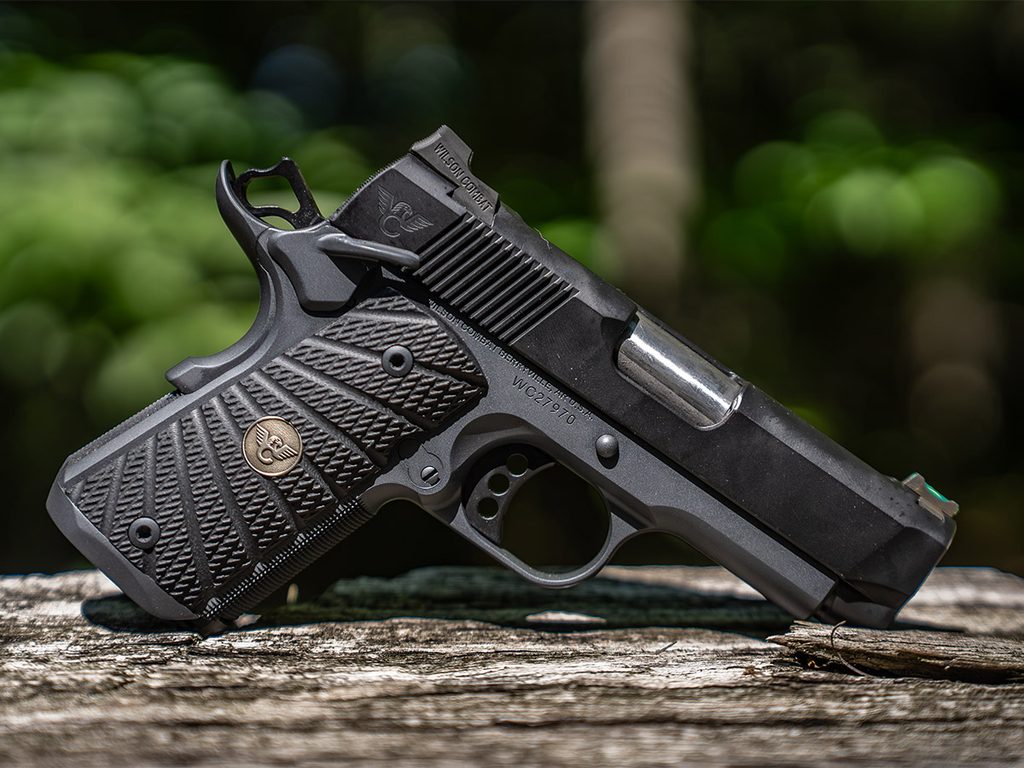
Wilson Combat Sentinel Specs
Chambering: 9mm Luger
Capacity: 8+1
Barrel: 3.6 inches (4.0 inches Sentinel XL) stainless steel, match grade
Length: 7.2 inches (7.6 inches Sentinel XL)
Sight Radius: 5.3 inches (5.6 inches Sentinel XL)
Height: 4.8 inches (4.9 inches w/ integral magazine well)
Width: 1.3 inches
Weight: 35.6 ounces (27.6 ounces Sentinel XL, 30 ounces Lightweight Sentinel)
Slide: Steel
Frame: Steel (Aluminum Sentinel XL and Lightweight Sentinel)
Finish: Armor-Tuff
Trigger: 3.5 pounds (as tested)
Sights: Battlesight rear, fiber-optic front
Accessories: Carry bag, test target, owner’s manual, extra fiber sight rod, wrenches, and free NRA membership
MSRP: $4,002.85 (Standard), $4,157.95 (Lightweight), $4,224.80 (with integral magwell) $4,624.95 (Sentinel XL)
Pros:
- Compact, easy to carry
- Crisp trigger, great overall shooter
- Very precise
- Good sights
- Reliable
Cons:
- Very expensive
- Pretty heavy
- Included magazine base pads are too thin
Wilson Combat Sentinel Black/Gray Armor-Tuff 500-9S
$3,299.95
What Is The Wilson Combat Sentinel?
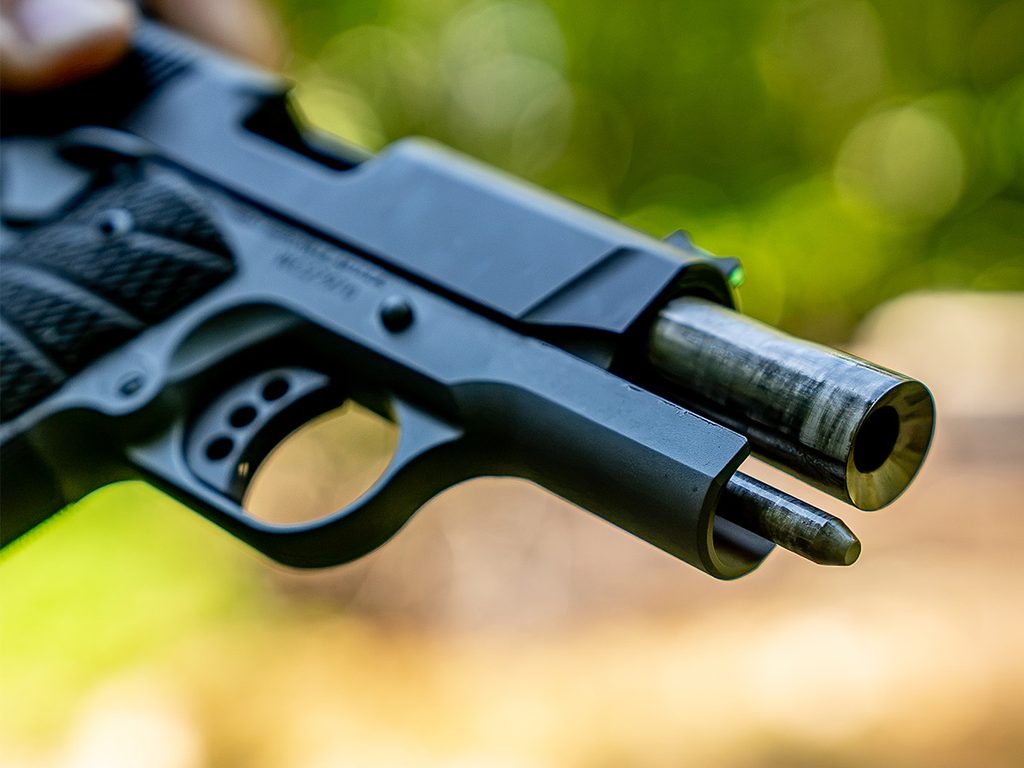
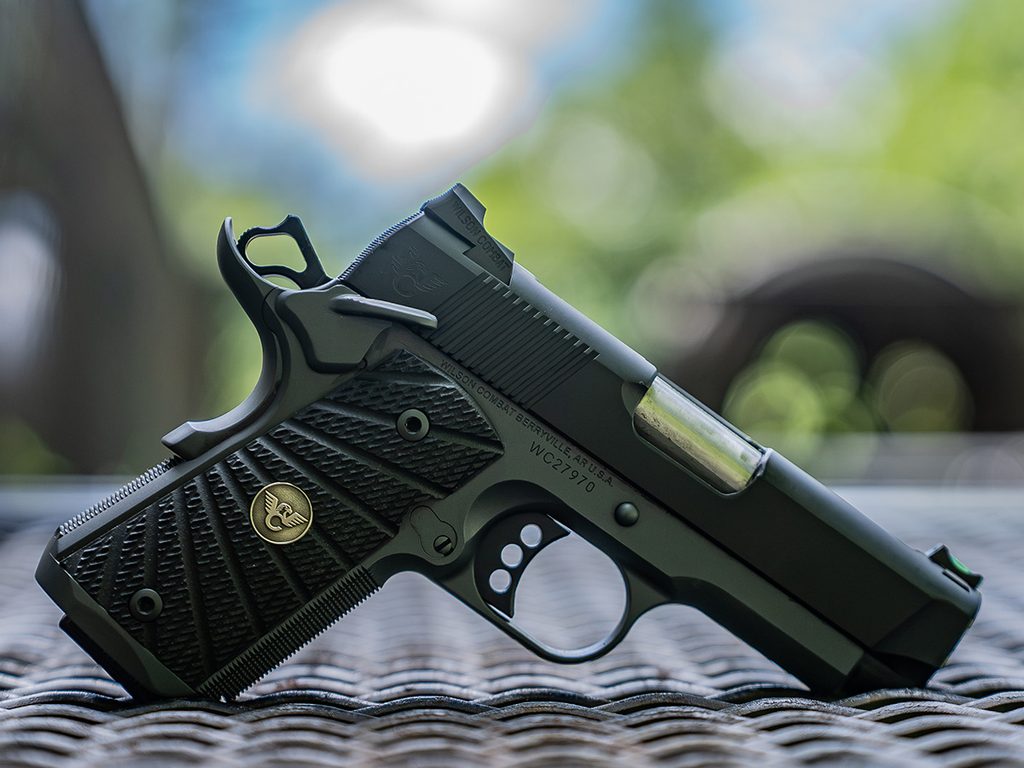
With it’s 3.5-inch barrel, the Sentinel is maybe best described as an Officer-sized 1911. The base model is built on a steel frame, with the option of an integral magazine well. Other features include a full-length guide rod and reverse recoil spring plug, a high-cut checkered front strap, checkered back strap, high-ride Bullet Proof grip safety, Bullet Proof ambidextrous thumb safety, and if you opt for the Sentinel without the integral magazine well, it comes with an opened up and contoured magazine well. The slides on both pistols are carbon steel, have 30-lpi serrations on the top flat and 40-lpi serrations on the rear. The slide stops are countersunk, and the nose of the slides have ball end mill cuts.
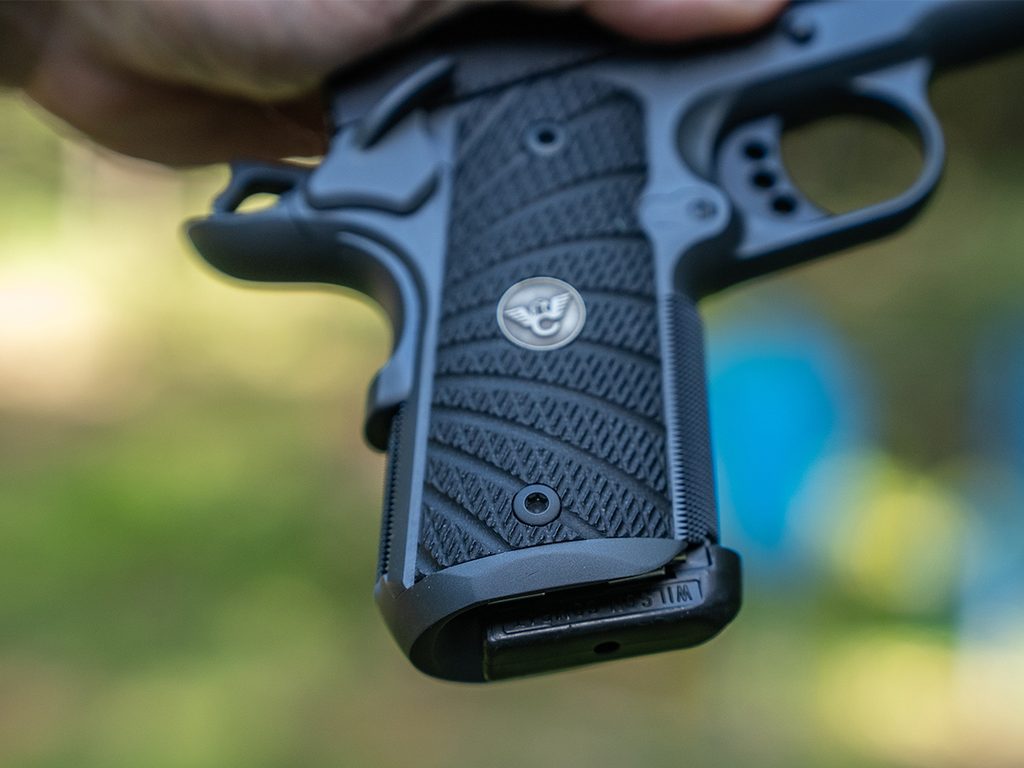
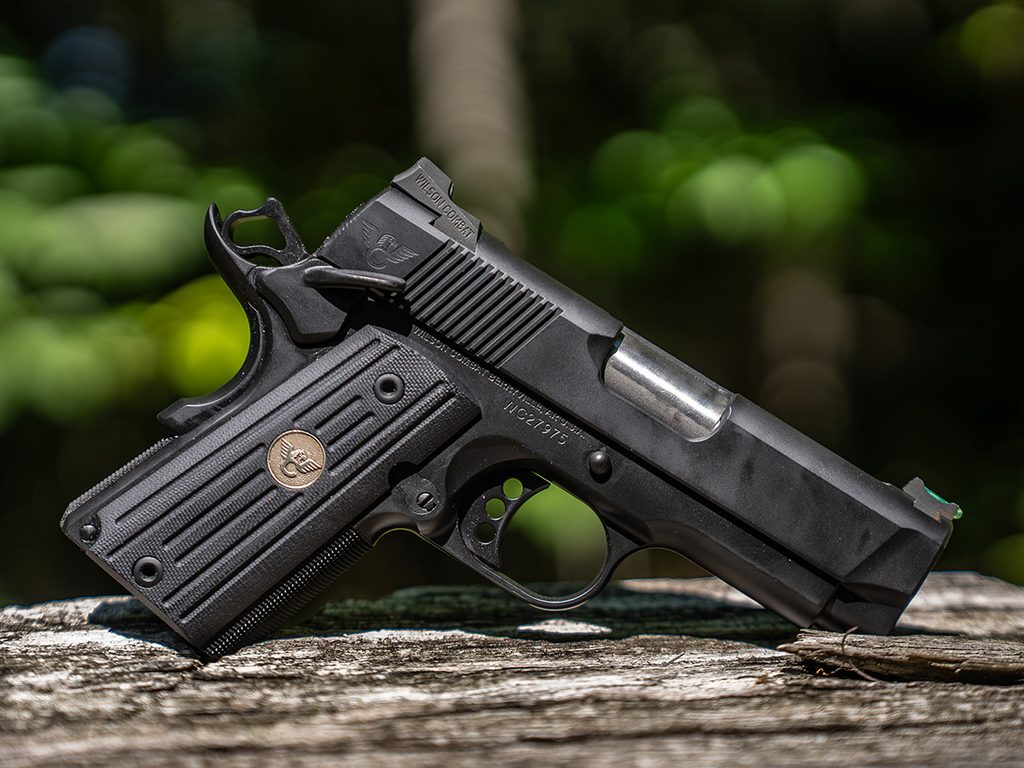
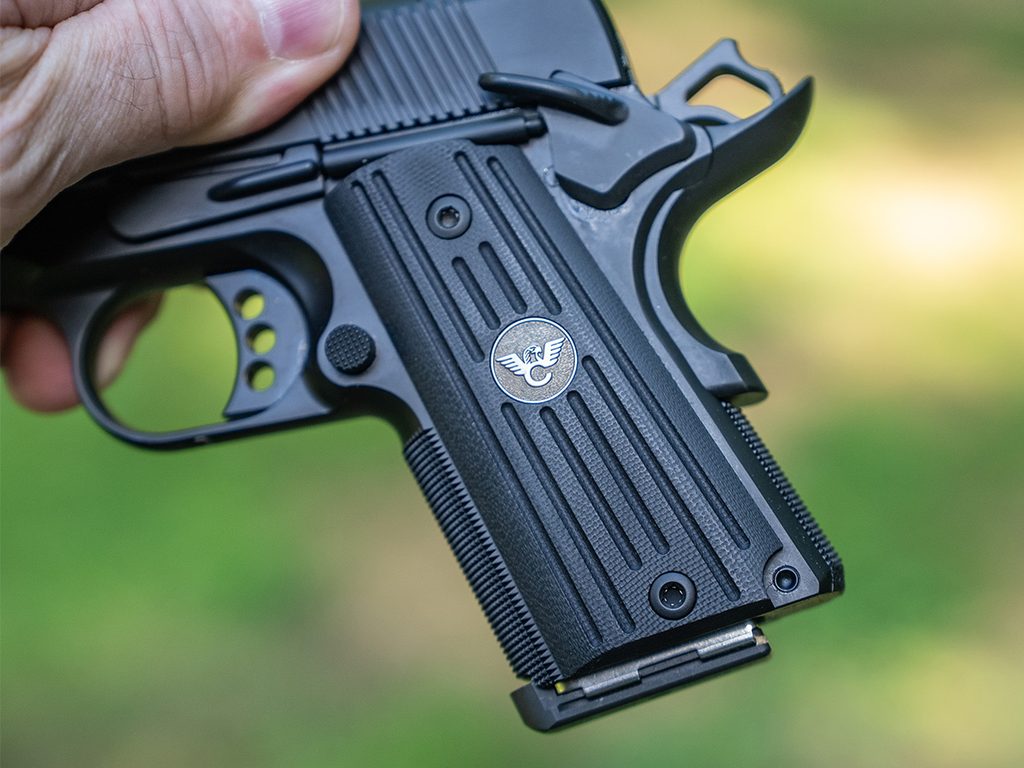
The grips on the Sentinel are slimline G10 and offered in two styles, the pistol has an Armor-Tuff finish, a crisp trigger, and it comes standard with Wilson Combat’s battlesight rear sight and fiber-optic front sight. Also, as you would expect with any fighting pistol from Wilson Combat, all the edges on these pistols are muted, so there is nothing sharp to eat away at your hands during manipulation. You won’t need to wear gloves and look like some sensational social media influencer to shoot this pistol. Additionally, each Sentinel pistol comes with its own multi-pocket Wilson Combat logoed range bag with separate pouches for magazines.
The Lightweight Sentinels
Wilson Combat is also offering a lightweight Sentinel and a Sentinel XL. Bill Wilson told me, “One of my personal favorite carry guns is my 4-inch Sentinel XL due to its good sight radius and very concealable grip.” The Sentinel XL is offered in 9mm Luger and .38 Super, and it has the same style grip frame, but instead of being made of steel, it’s made of aluminum. Additionally, the Sentinel XL has a 4-inch barrel and a slide to match. If light weight is important to you, but you want a slightly longer sight radius, the XL is probably a better option. The other lightweight Sentinel option is the base model Sentinel with an aluminum frame. Other than its 5-ounce lighter heft, it is identical to the standard Sentinel.
The Sentinel From the Bench
Most gun reviews are based on examples of one, because that’s how this industry works. A manufacturer introduces a new gun and they loan single examples out to various publications with hopes of receiving positive reviews. A lot of folks think gun writers get to keep the guns sent to them to review, and I wish it were so—especially with the Sentinel. It happens sometimes—rarely—but most often the guns must be returned or purchased at a wholesale price. For some reason Wilson Combat sent me two Sentinel pistols to test, and instead of sending one back I decided to just test them both. This makes this review much more representative of what you could expect if you purchased a Sentinel, because it is not an example of one.
Wilson Combat pistols come with a test target fired at 15 yards from a rest. Their process for precision testing is demanding and intense; I’ve witnessed and participated in it. The Sentinel, like most Wilson Combat pistols, comes with a 1.5-inch precision guarantee at 25 yards, but Wilson Combat tests their pistols at 15 yards with a sub-0.9-inch three-shot benchmark. The three-shot group on the test target with the first pistol measured 0.384 inch, and 0.701 inch for the other pistol. Extrapolated by distance, this equates to 25-yard group sizes of 0.5 inch and 1.16 inches, respectively. That’s impressive from pistols with a 3.5-inch barrels.
I did my precision testing from a sandbag rest at 10 yards, but I fired three, five-shot groups with each load from each pistol. (Nine groups with each pistol.) My overall average for the 18 five-shot groups fired with five different loads was 1.20 inches. The last time I visited Wilson Combat and shot alongside Austin Crawford who tests a lot of their guns, my groups averaged about 20 percent larger than his. Regardless, two pistols of the same model with 3.5-inch barrels that will average 1.2 inches for 18, five-shot groups with five different loads are good to go in my book. I can’t imagine a defensive shooting situation where you would need more precision.
Wilson Combat Sentinel Pistols Shooting Results
| LOAD | MV (fps) | SD (fps) | ME (ft-lb) | PRECISION |
| SENTINEL #1 | ||||
| Lehigh Defense 90-grain XD | 1,305 | 13.5 | 340 | 1.10 |
| Federal 124-grain Punch | 1,087 | 8.5 | 325 | 1.34 |
| Hornady 135-grain Critical Duty | 1,083 | 2.6 | 351 | 1.14 |
| Average: 1.19 | ||||
| SENTINEL #2 | ||||
| Federal 124-grain Punch | 1,084 | 7.8 | 324 | 1.35 |
| Remington 124-grain Black Belt | 1,055 | 16.1 | 306 | 1.00 |
| Federal 135-grain Hydra-Shok Deep | 1,003 | 14.1 | 301 | 1.27 |
| Average: 1.21 | ||||
| Overall Average: 1.20 |
On The Range With The Sentinel
After conducting tests and evaluations of defensive handguns for magazine review for more than a quarter century, I’ve pretty much decided on two standardized drills to use as a comparison. The first is the Forty-Five Drill, which requires you to draw from concealment and put five shots into a 5-inch circle from 5 yards in less than 5 seconds. This is mostly a pass-or-fail proposition—if I cannot do this with a handgun, I do not consider it appropriate for concealed carry. I had no trouble meeting this standard with both Sentinel pistols.
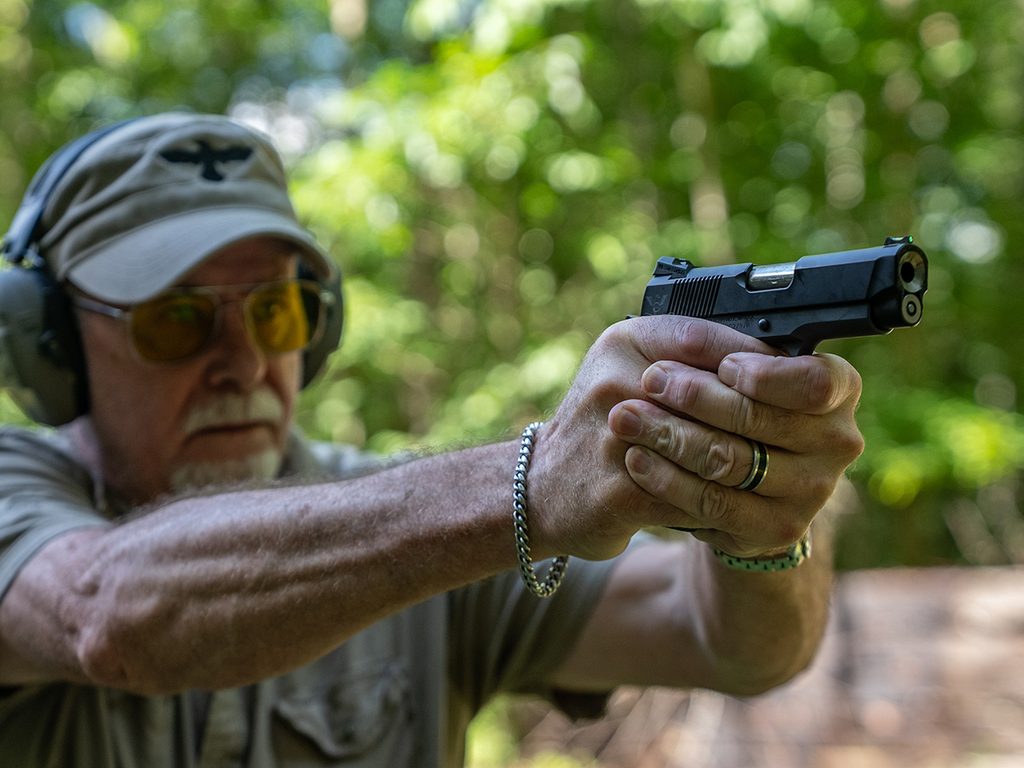
The second drill is a bit more involved. It helps me evaluate most every aspect of a defensive handgun. The Step Back Drill is fired from 5, 10, 15, 20 and 25 yards. You draw from the holster and engage an 8-inch target with two shots at each distance, timing each two-shot string separately. A miss during the process is considered a failure, and after you fire all 10 shots you add the five times together. The goal is 10 hits in a maximum of 20 seconds. For me, anything less than 15 seconds with open sights or less than 13 seconds with a dot sight is exceptional. My average time on this drill for 10 runs—five runs with each Sentinel—was 15.02, with a best run of 14.54 seconds. For me, that’s great performance with a 3.5-inch barreled pistol.
Of course, the sights are very good, and the trigger is even better, but I think I shot so well with these short-barreled pistols because of their weight. Most pistols with barrels this short weigh about 25 percent less than the steel-framed Sentinel, and this exponentially increases recoil and the time to recover between shots. Compared to pistols with the same external dimensions, the steel-framed Sentinel will tug a bit more on your belt, but you’ll appreciate that weight when the shooting starts. These guns are incredibly soft shooting.
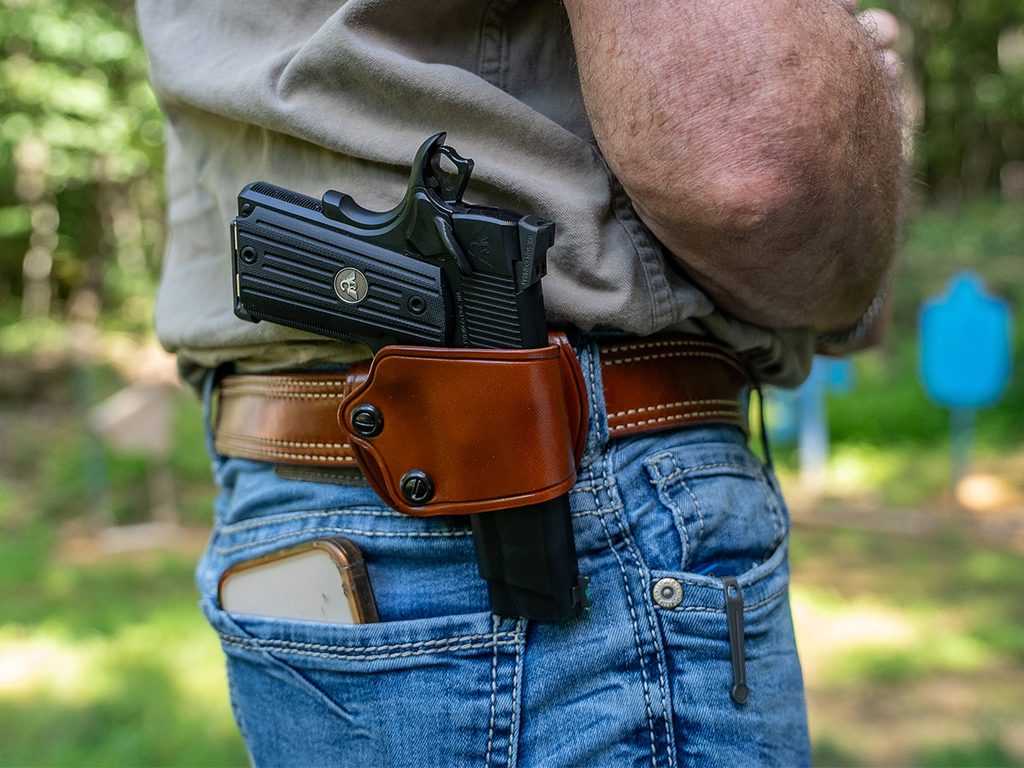
I felt the safeties provided the exact amount of resistance for safe and practical operation, that the tightly fitted slide was easy to cycle, and really appreciated the fact that there were no sharp edges on the guns. Through the firing of 500 rounds of ammo from both pistols—total—I only had a single stoppage. I tested these pistols dry, just as they came out of the cool carry bag Wilson Combat supplies with each pistol, and at about round 200 I had a stove pipe with one gun while shooting some light-recoiling remanufactured ammo, weak hand only. I gave each pistol a squirt or two of gun juice, and after that there were no issues of any kind.
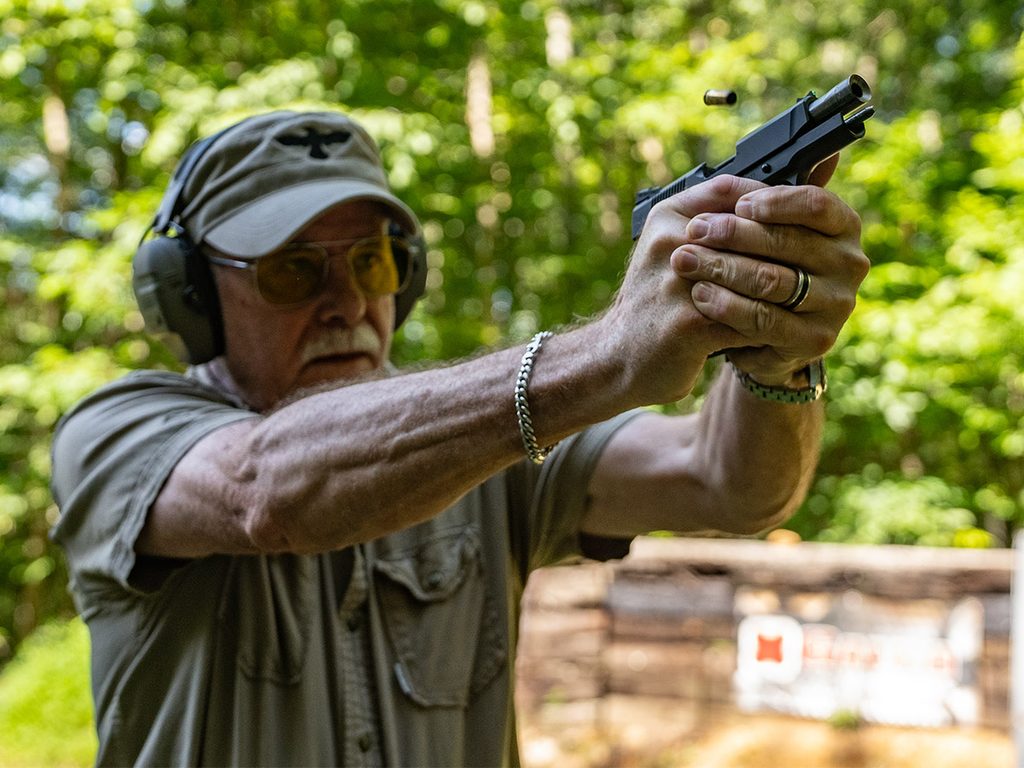
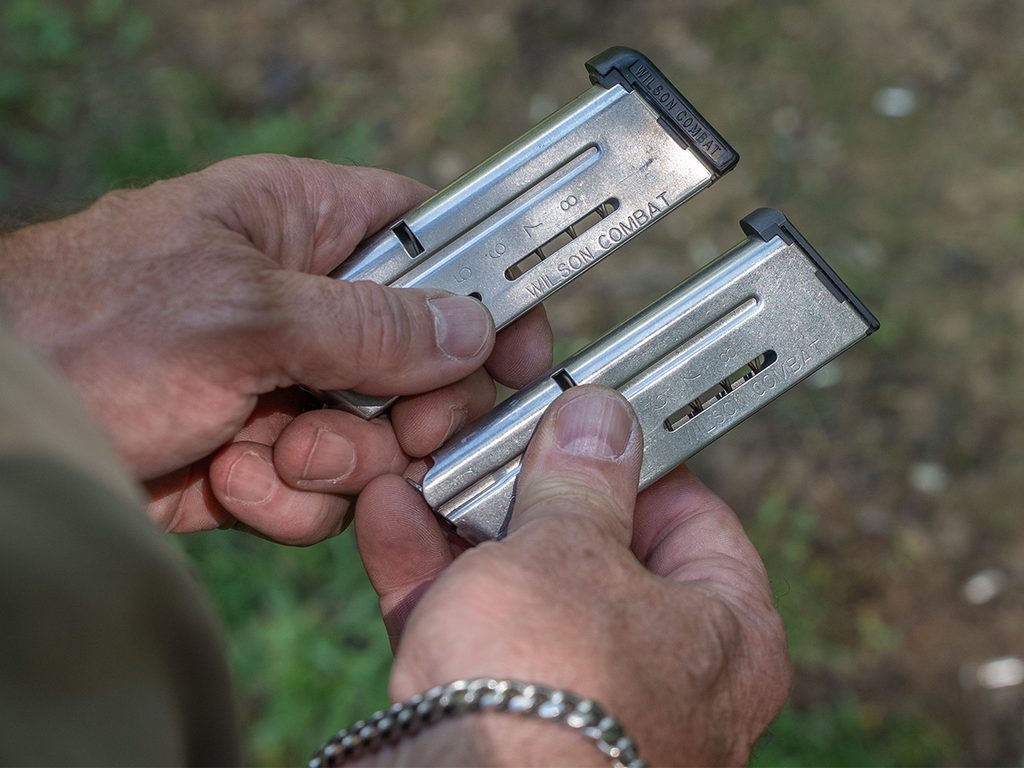
My only complaint was the thin magazine base plate that comes on all the Sentinel magazines. When I shoot the Step Back Drill to test handguns, I conduct an untimed reload after each two-shot string. When reloading the Sentinel with the integral magazine well, the magazine base plate rides just below the edge of the magwell and could—if your reload is a bit off—fail to fully seat. This is, of course, easily fixed by ordering thicker base plates from Wilson Combat. You can get three for $6.36. If I opted for the Sentinel with the integral magwell—and that’s the one I liked best—I’d add these thicker base plates to my order.
Final Thoughts
When pistols get small, they often become unreliable and more difficult to shoot. That’s not the case with the Wilson Combat Sentinel pistols. Not only were they reliable, but they were also accurate, soft shooting, and comfortable to carry. Routinely smacking an 8-inch steel plate, at 25 yards, with two shots from the holster in an about 4 seconds, speaks volumes about the shootability of these 3.5-inch barreled, open-sighted pistols. That kind of performance is what many look for in an everyday carry self-defense handgun.
Of course, 4 grand is a lot of money to spend on a pistol, and some might look at a purchase like this as foolish. However, when you look at the things in life you use and want to trust everyday of your life—like automobiles, refrigerators, pocketknives and pistols—there’s reasons a lot of folks never consider base model cars and trucks, $5 pocketknives, or refrigerators and pistols that cost less than a smartphone. My advice? If you like good guns, save longer and spend the money. Your shooting pleasure and pride of ownership will increase, but possibly and most importantly, your life could depend on it.
9mm Pistol FAQ
Yes, and many experts would even argue that a 9mm pistol is the best choice for self-defense. It may not be as powerful as 10mm Auto or .357 Magnum, but cartridges that big are difficult to shoot quickly and accurately as well. For most people, their ability to make good hits with a 9mm will be more effective at stopping a threat than having a bigger bullet. Further, defensive projectile technology has progressed leaps and bounds, so modern 9mm self-defense ammo provides excellent, reliable expansion and penetration.
Yes, for the most part. Sometimes it’s best to start a first-time shooter with a .22 LR, but unless they’re small children, they should quickly be able to graduate to and handle a 9mm pistol. For able-bodied adults looking to get a pistol for defense, sport shooting or plinking, 9mm is the best choice.
Not particularly, but it depends. Somewhat simplifying things, a handgun’s recoil is mainly a factor of the pistol’s weight and the power of the cartridge in question. A very small, light 9mm pistol loaded with a powerful +P will definitely kick hard, but a full-size steel gun loaded with range ammo will not. Generally speaking, 9mm is not considered to be a hard-kicking round.
Editor’s Note: This article originally appeared in the December 2026 issue of Gun Digest the Magazine.
More 9mm Carry Pistols
Read the full article here