

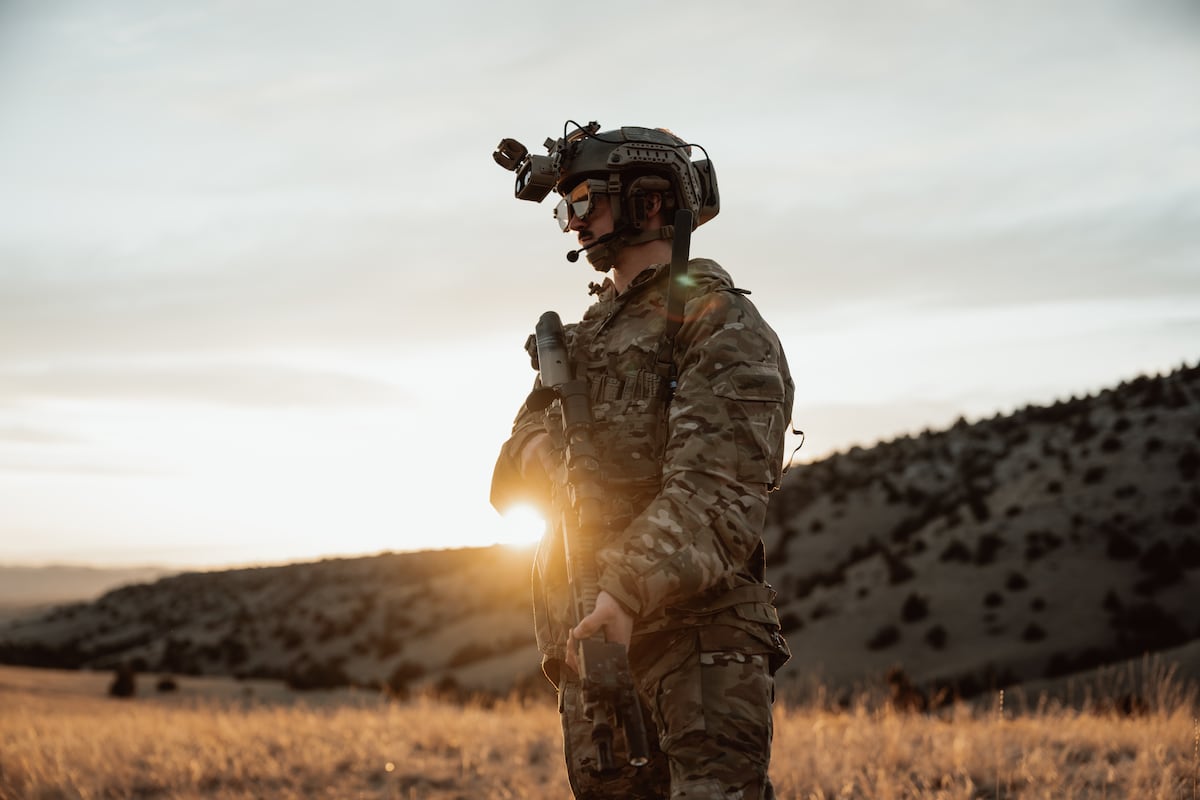
Last year, Washington, D.C.-based Rivet was one of two contractors selected for the U.S. Army’s Soldier Borne Mission Command program, an effort to develop a device that enhances situational awareness and communication on the battlefield.
Since then, Rivet has raised $55 million in Series A financing and delivered its first 70 prototypes to the Army, according to co-founder and chief executive Dave Marra.
While the other contractor, Anduril, developed a headset resembling the original Integrated Visual Augmentation System, or IVAS, which it had also helped develop, Rivet took a different approach: a pair of militarized smart glasses called the Rivet Hard Spec.
Marra explained in an interview with Military Times that the idea behind the Hard Spec is helping people who “do hard jobs in hard places.”
While the initial goal was to give infantrymen actionable information for targeting and navigation, the application has expanded to other tasks, including technical and mechanical work that soldiers may not perform regularly.
He explained that the idea isn’t to turn an infantryman into an IT specialist or mechanic, but rather, the glasses could give a trained professional the correct procedures for a task without requiring a physical manual.
“So it’s not just like, ‘Hey, we want to create one solution for every military occupational specialty,’” Marra said. “[It’s] what you want to do as a multifunctional soldier or Marine or airman. And this kind of technology is a great accelerator to exactly that.”
He added that Rivet is also adapting the technology for other fields, primarily aerospace manufacturing and aircraft and motor pool maintenance.
“If you happen to forget or you’re not 100% proficient in this role or you don’t do this particular procedure every single day, you can very easily see how a step could be overlooked, especially when you’re in a high-stress environment,” he said.
The company’s longer-term goal is even more ambitious: enabling soldiers to use the glasses to command AI agents that can control robots and drones on the battlefield.
Marra said that means moving beyond using AI to provide a reasoned response to a complicated question.
“I’m asking an agent to go do something on my behalf,” he said. “What we want to get is where an agent and a robot can task each other.”
He said soldiers should be able to communicate with those systems “in common language, not command language.”
For example, he said, a soldier could tell a drone: “‘Hey, there is a target over that hill. Please orbit over that hill and reconnoiter it and send me back the video.’”
If that sounds familiar, it’s because the concept is almost identical to the MacGuffin in the 2019 film Spider-Man: Far From Home. In the movie, Spider-Man and the villain Mysterio fight over a pair of glasses that connect the wearer to an AI-enabled global defense system.
“And the best way to do that today is having a pair of glasses that has eyes and ears on [the AI],” Marra said. “So in many cases, I would say that we’re putting eyes and ears on AI, and then allowing this kind of agentic ensemble to happen within the human workforce.”
Daniel Terrill is a contributor to Military Times. He’s been reporting on military issues, the gun industry, and the outdoors for nearly two decades. Although writing is his passion, he’s been a Marine, police officer, and, perhaps the most dangerous job of his career, a substitute teacher.
Read the full article here