

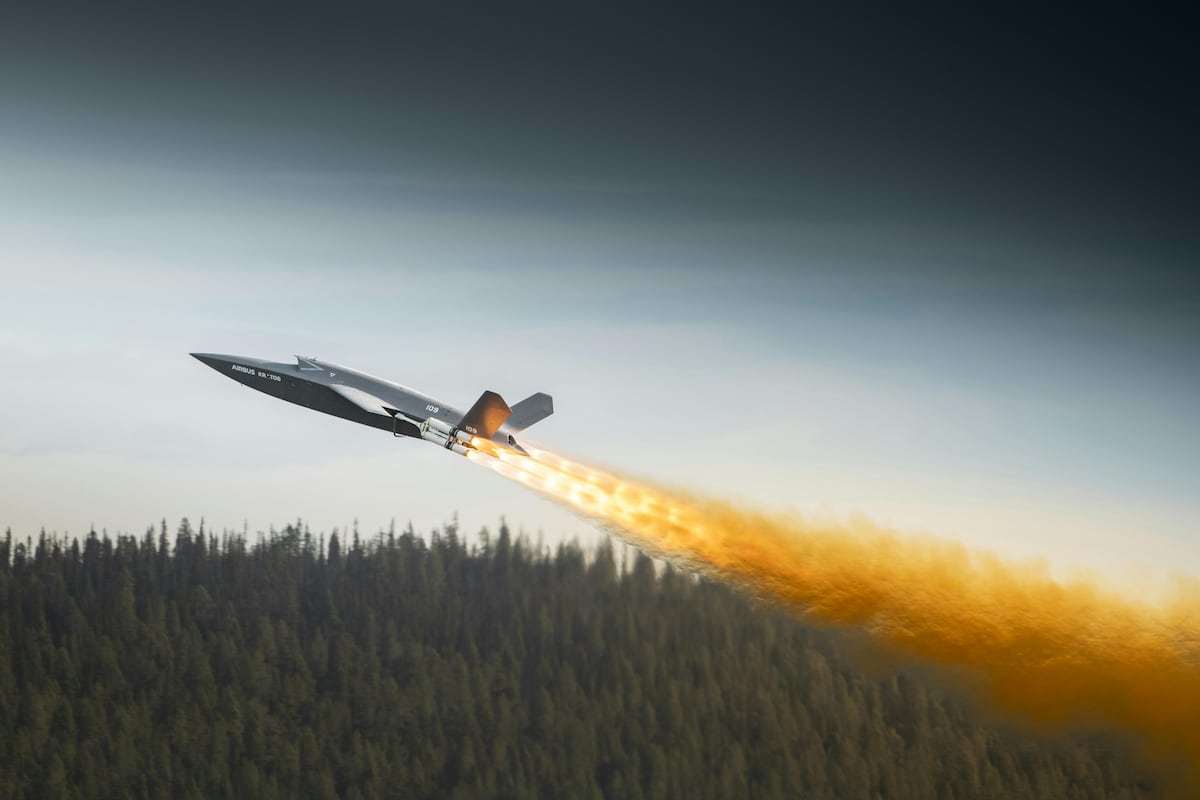
The California-based defense company Kratos announced this week the first test flight of the uncrewed combat aircraft known as the U740 Valkyrie over European skies, as well as the first successful flight tests of a new turbojet engine designed for small aerial systems.
The U740 Valkyrie was developed through a partnership with the Dutch company Airbus in support of German and other European armed forces.
In a joint statement, Mike Schoellhorn, the chief executive of Airbus Defence and Space, explained that the Valkyrie combined Kratos’ low-cost airframe with Airbus’ sovereign European mission system.
“In an increasingly complex and contested threat environment, air forces require affordable combat mass today,” he said, adding that the Valkyrie will also support crewed combat aircraft with extended range, firepower and survivability.
The companies said the test flight accomplished all of their goals, including an independent rocket-assisted takeoff, maneuvers at various altitudes, speeds up to Mach 0.8, and in-flight mission adjustments.
According to the statement, the Valkyrie runs 30 feet in overall length with a 27-foot wingspan. It features an internal weapons bay for air-to-air and air-to-ground munitions. Additionally, it has a max take-off weight of more than 6,000 pounds, a range exceeding 3,000 miles and a service ceiling of 45,000 feet.
The companies added that the successful demonstration paves the way for more sophisticated test flights with Airbus’ Multi-platform Autonomous Reconfigurable and Secure mission system, or MARS.
They described MARS as the aircraft’s “European brain” because humans will still control all critical decisions despite the AI-enhanced software that allows the system to function autonomously.
Eric DeMarco, the president and CEO of Kratos, said that although “first flights typically include plenty of learning opportunities,” he called the test “an amazing success” because of the maturity of the technology.
The J85 Engine
This week, Kratos also announced recent flight tests of the TDI-J85 engine across multiple configurations, meaning it demonstrated capabilities for cruise missiles, decoys and unmanned aerial systems, or UAS.
“Our successful flight tests across diverse deployment methods prove the versatility and reliability of the TDI-J85 engine,” said Joseph Kovasity, a senior vice president of Kratos.
According to the statement, the J85 engine successfully launched from standard rail or zero-length launchers, an aircraft cargo bay and a launch container.
Kovasity added that Kratos recently scaled up operations because of manufacturing orders to build 3,000 engines in 2027, but the company is positioning itself to produce up to 10,000 engines or more per year by 2029.
Daniel Terrill is a contributor to Military Times. He’s been reporting on military issues, the gun industry, and the outdoors for nearly two decades. Although writing is his passion, he’s been a Marine, police officer, and, perhaps the most dangerous job of his career, a substitute teacher.
Read the full article here