

NEWYou can now listen to Fox News articles!
“In ordinary speech, no one would say that a person ‘arrives in’ a place … before the person enters that place.”
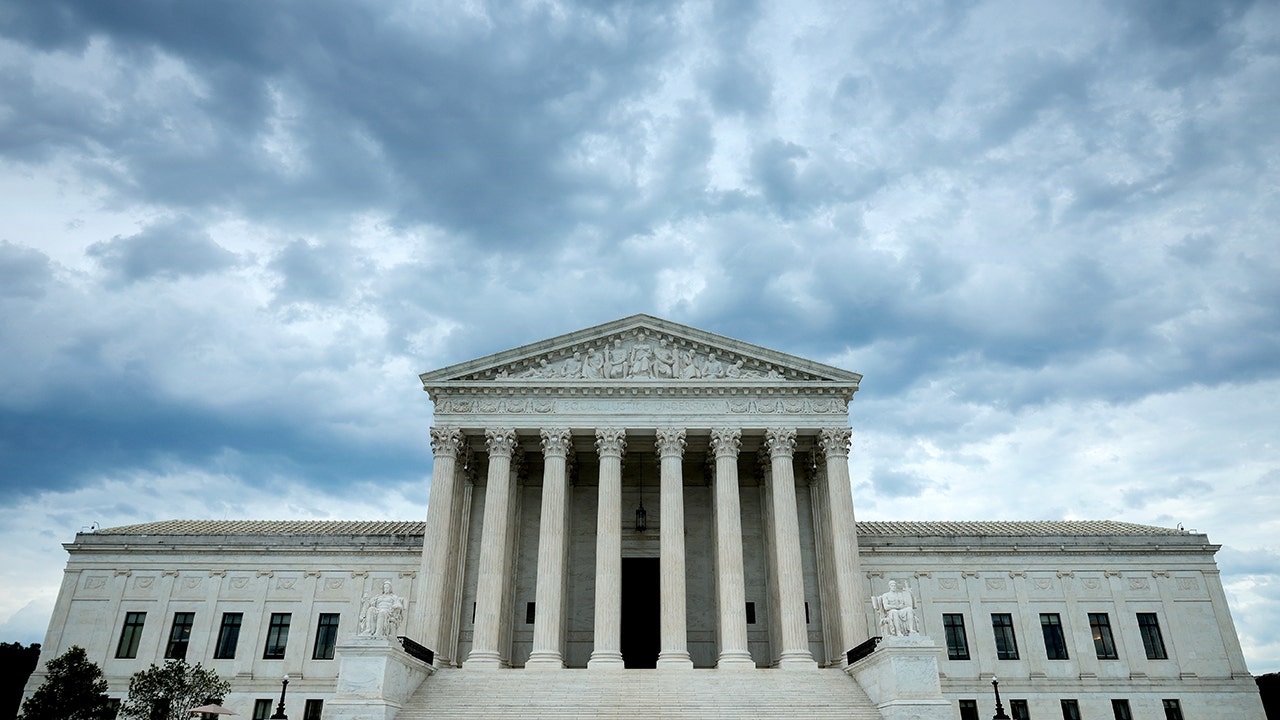
Those words may seem ripped from the pages of Dr. Seuss, but they are taken from the 6-3 majority opinion of Justice Samuel Alito iin Mullin v. Al Otro Lado. They captured the lost-in-translation character of the Court’s fight over whether undocumented persons must be physically present in the United States to make an asylum claim.
In one of a pair of major immigration wins for the Trump administration, the Court ruled that asylum seekers who are stopped on the other side of the Southern border are not present in the United States. If treated as inside the country despite being outside it, these individuals would be allowed to enter and remain while their asylum claims are pending.
The case highlights the lengths to which the Biden administration went to facilitate the entry of undocumented persons into the country. It rescinded a policy of “metering” that was put into place by the Obama administration (and later restored and expanded by the Trump administration).
SUPREME COURT AGREES TO REVIEW TRUMP ADMIN EFFORT TO LIMIT IMMIGRANT ASYLUM PROCESSING CLAIMS AT BORDER
In seeking to bar Trump from enforcing the same policy as the Obama administration, the three liberal justices sounded positively Clintonesque in debating what the meaning of “in” is. Justice Sonia Sotomayor denounced the majority’s “illogical interpretation is driven almost entirely by a fixation on a single word: ‘in.’ Words, however, must be read in context and with attention to how they fit into the statute as a whole.”
In their view, “contextual” reading means that you can be “in” the United States without actually being “in” the United States.
The sharp disagreement in the opinions spilled over to the release of the opinions. Justice Alito read a summary of his opinion, followed by a more lengthy reading by Justice Sotomayor of her dissent. The stinging dissent produced a rare rebuttal from the bench by Alito, who was surprised by the extended comments and said that, if he had not been blindsided, he would have said more, including how “the policy in question was adopted by two very different administrations.”
The court also delivered a major victory in Mullin v. Doe, upholding the right of the administration to strip more than 356,000 Syrian and Haitian immigrants of temporary protection status. Again, lower courts afforded the Obama and Biden administrations greater leeway in granting such status than Trump in rescinding it.
The combination of the two opinions offers significant advances for the administration in addressing millions of undocumented persons in this country.
In her dissent in Mullin, Sotomayor invoked the image of the voyage of the M. S. St. Louis, where Jews fleeing Nazi Germany were not allowed entry in various countries only to be returned to Germany, where many died in the Holocaust.
The problem with the analogy is that all of those on the St. Louis were demonstrably in flight from lethal persecution. Virtually all of the asylum claims made at our borders are rejected as unsupported or invalid. Immigration groups hand out material across the border, coaching immigrants to claim asylum status to guarantee that they can stay in the country for years before any final adjudication can be made. The acceptance rate of these claims is currently below five percent.
CLICK HERE FOR MORE FOX NEWS OPINION
The question is how to limit such constructive entries if being “in” the United States does not require actually being in the United States. More importantly, absent a clear legal basis for such constructive entries, it is not clear why courts should be able to dictate such policies. The control of our borders has long been an area marked by heavy deference to the Executive Branch. During the Biden administration, courts often embraced that discretion as the administration allowed over ten million unvetted immigrants to enter.
Trump was elected on the pledge to reverse these policies by using the same discretion that his predecessor employed to open the border.
The dissent shows how untethered these opinions are from not just “ordinary speech,” but principles of judicial restraint. Placing these disputes in “context” is a liberating construct that allows a court to read the words “arrives in the United States” to include those outside of the United States. It also gives a glimpse at the likely approach of the newly expanded Supreme Court that Democrats are pledging if they regain power.
The decisions in Mullin v. Doe and Mullin v. Al Otro Lado will not erase the backlog in immigration cases or remove millions of unvetted immigrants. That will require both an expansion of our immigration courts and real reforms to further streamline the removal process. However, in two 6-3 opinions, the administration regained substantial authority in the management of our borders.
CLICK HERE TO READ MORE FROM JONATHAN TURLEY
Read the full article here