

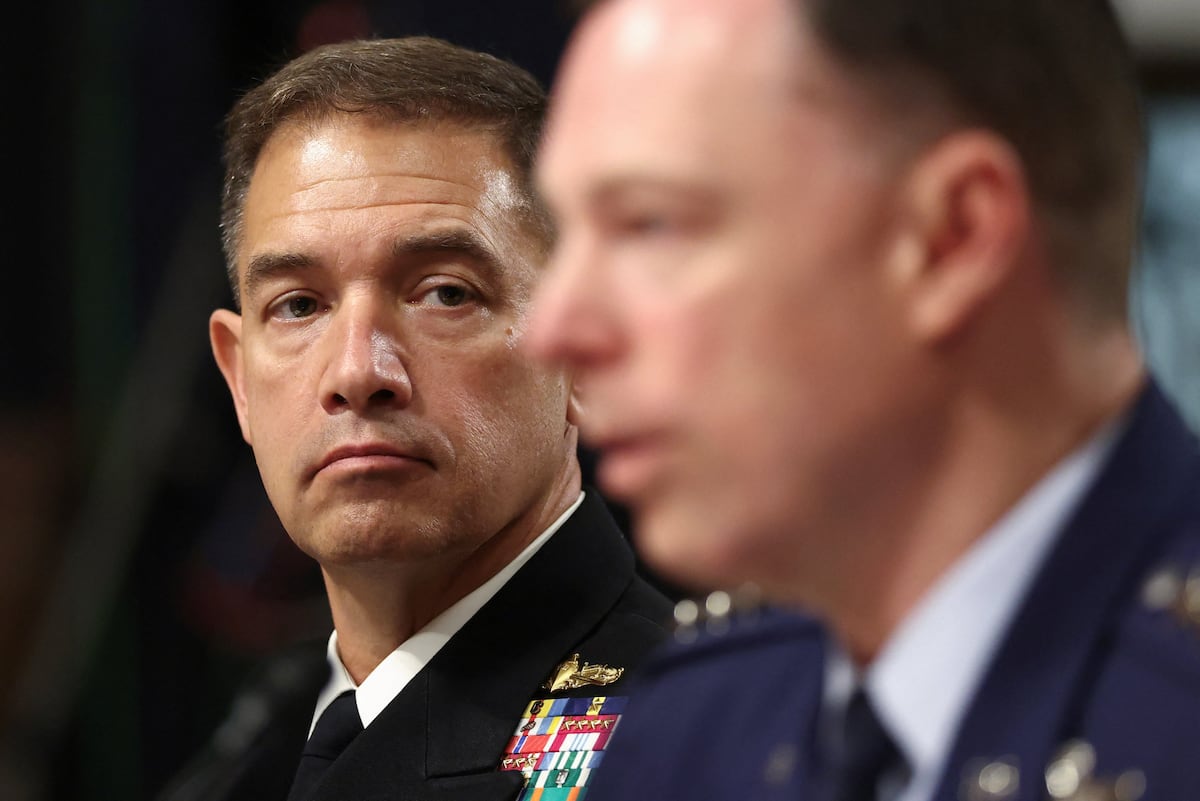
America’s 38-day bombing campaign against Iran has diminished the Islamic Republic’s ability to threaten global security, but has not yet eliminated the threat altogether, Adm. Brad Cooper, the chief of Central Command, told lawmakers on Thursday.
“It’s a very large country,” Cooper testified before the Senate Armed Services Committee. He acknowledged that Iran still possessed “a very moderate, if not small, capability” to conduct strikes on regional neighbors.
Washington and Tehran remain locked in a month-long stalemate in the Strait of Hormuz, with no clear path forward as both sides have rejected proposed off-ramps from the crisis.
Initially, Iran retaliated for the joint U.S.-Israeli attack on its territory by throttling traffic in the waterway — where roughly one-fifth of the world’s oil typically flows. The Iranians accomplished this in part through the mere threat of naval mine warfare, though some vessels were also attacked. The United States, in turn, imposed a blockade on all vessels entering or leaving Iranian ports.
“The Iranian capability to stop commerce has been dramatically degraded through the straits,” the CENTCOM commander said. “But their voice is very loud, and those threats are clearly heard by the merchant industry and the insurance industry.”
Cooper — who did not address how the impasse in the strait might be resolved — asserted that U.S. forces had severely degraded Iran’s warfighting capacity, including the elimination of roughly 90% of its inventory of more than 8,000 naval mines.
He also declared that U.S. forces had “met every military objective” under Operation Epic Fury, citing the destruction of 90% of Iran’s defense industrial base.
RELATED
In recent days, media reports have cast doubt on the most expansive claims made by the Trump administration about military triumph over Iran, however. A New York Times report on Tuesday, for example, indicated that U.S. intelligence agencies believe Iran has held onto about 70% of the missiles it had before the war and that it retains access to about the same proportion of its mobile launchers.
Cooper declined to discuss specific intelligence assessments, but contended that the number he’s seen in “open source are not accurate.”
He added: “It’s more than just the numbers. It’s the command and control that’s been shattered. It’s the significant degradation and capability. And it’s the lack of any ability to then produce any missiles or drones on the backend.”
More broadly, Cooper insisted, “Iran has a significantly degraded threat. They no longer threaten regional partners, or the United States, in ways that they were able to do before, across every domain.”
“Most notably, we degraded Iran’s ability to project power outside its borders and threaten the region and threaten our interests,” Cooper continued. “Today, Hamas, Hezbollah, and the Houthis are all cut off from Iran’s weapons and support.”
Those groups, commonly known as Iran’s “Axis of Resistance,” have enabled the Islamic Republic to wield influence across the Middle East while maintaining plausible deniability regarding their armed actions. In the 30 months before Epic Fury commenced, Cooper said, those aligned militias carried out more than 350 attacks on U.S. service members and diplomats stationed in the region.
Tanya Noury is a reporter for Military Times and Defense News, with coverage focusing on the White House and Pentagon.
Read the full article here