

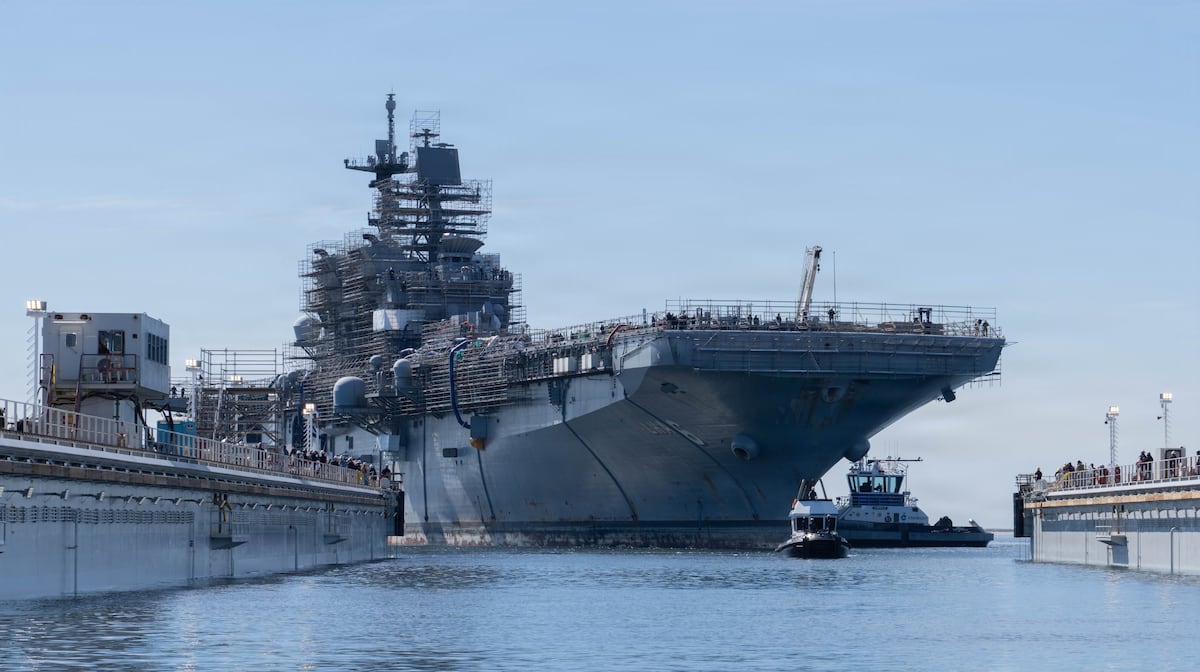
The U.S. Navy’s top civilian said Tuesday that the service would look into the concept of utilizing foreign partners to manufacture the nation’s warships as it seeks to address its growing shipbuilding needs.
Navy Secretary John Phelan told reporters at a media roundtable at Sea-Air-Space 2026 in Washington that the Navy was facing a labor capacity problem at home and needed help remediating it.
“Everything’s on the table,” Phelan said. “We just need to look at it, understand it, understand the implications behind it and decide if we think that makes sense or not.”
The secretary cited previous successful maintenance, repair and operations (MRO) work with Korea and Japan as examples of how allies could alleviate pressure on the U.S. shipbuilding workforce.
South Korean shipbuilding companies HD Hyundai Heavy Industries and Hanwha Ocean have already won three MRO contracts from the U.S. Navy in 2026, according to The Chosun Daily, a South Korean publication.
The majority of South Korean MRO contracts are for U.S. Navy ships based in the U.S. Navy’s 7th Fleet, headquartered in Japan.
Chief of Naval Operations Adm. Daryl Caudle met with South Korean shipbuilders in November 2025 during his first international trip as CNO, learning about shipbuilding practices that could help reinvigorate the U.S. maritime industrial base.
Phelan on Tuesday also said the Navy was going to try and revise contracting and the ways in which shipbuilders could be incentivized to work faster.
“One of the things we are going to do in our contracting is if you beat schedule, you’re going to get a bonus, but you’re going to share it with the workers,” Phelan said.
And there’s evidence to suggest companies are up for the challenge.
Contractors who received multi-ship orders were capable of shaving eight to 11 months off of building that same ship, Phelan said.
The proposed $1.5 trillion fiscal 2027 Defense Department budget is asking Congress for $65.8 billion to dedicate to shipbuilding, specifically 18 battle force ships and 16 auxiliary ships meant to fulfill the Golden Fleet initiative President Donald Trump announced last December.
The U.S. Navy’s current fleet sits at nearly 300 ships, but the service has previously announced a goal of boosting that number to 381 over the next 30 years.
Riley Ceder is a reporter at Military Times, where he covers breaking news, criminal justice, investigations, and cyber. He previously worked as an investigative practicum student at The Washington Post, where he contributed to the Abused by the Badge investigation.
Read the full article here