

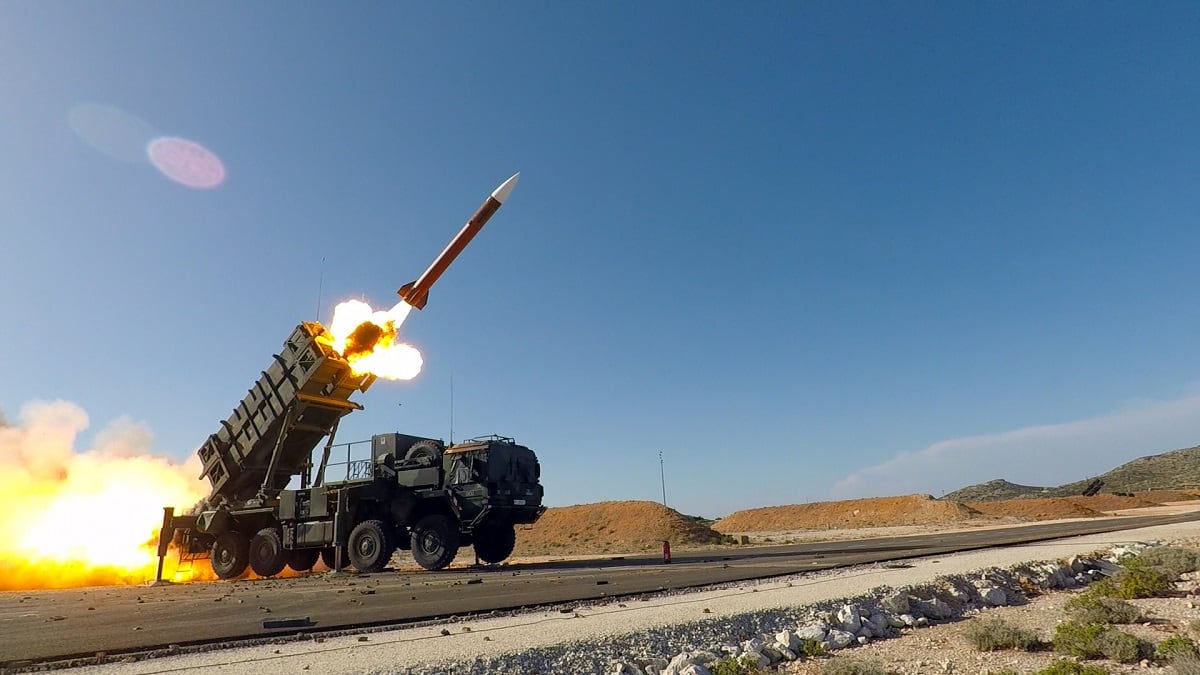
LONDON – Lockheed Martin on Monday introduced a cheaper Patriot interceptor as the U.S. and partner nations grapple with the exorbitant costs of shooting down cheap drones and missiles.
The PAC-3 Adapted Capability Effector, or ACE, will cost less than half of what a PAC-3 Missile Segment Enhancement, or MSE, interceptor costs, the defense firm said, and can be used with legacy equipment.
The announcement, which came during London’s 2026 Farnborough Airshow, comes as the U.S. looks to reduce its dependence on expensive interceptors to combat mass-produced munitions, a juxtaposition that has come under increased scrutiny as American forces have blown through the country’s finite interceptor stockpile to combat Iran’s relatively inexpensive drones during Operation Epic Fury.
The PAC-3 interceptors cost an estimated $4 million, far more than the $35,000 typical price tag of an Iranian Shahed drone. Experts warn that the U.S.’ increased interceptor use has raised concerns about whether stockpiles can be replenished quickly enough to sustain a prolonged campaign.
The PAC-3 ACE is designed to combat airbreathing threats — weapons that rely on oxygen for propulsion — cruise missiles and close- and short-range ballistic missiles.
Lockheed Martin said the new interceptor will still be compatible with the Patriot weapon system and Integrated Battle Command System, which enables the company to speed up development, an effort it says will be coordinated jointly with American and European partners.
U.S. forces in the Middle East have leaned heavily on the Patriot system, which uses radar to detect and track an incoming threat, calculate its trajectory and then guide an interceptor towards a predicted collision point, using a hit-to-kill method.
Patriot systems have become integral to Ukraine’s defense against Russia and as Kyiv’s missiles run out, the country pleaded for more interceptors before joining with nine other nations to create Freyja, a Patriot alternative, amid a global shortage of anti-ballistic interceptors.
The U.S. currently relies on a layered missile defense network that includes the Patriot system, the Navy’s Aegis Combat System — armed with SM-3 and SM-6 interceptors — and the Terminal High Altitude Area Defense, or THAAD.
In April, Lockheed Martin announced that the Navy was preparing to bring PAC-3 MSE interceptors to sea for use by its Aegis system, which uses advanced radars to identify, track and then guide missiles. The company was awarded a multimillion dollar contract but did not specify a dollar amount or timeline in the announcement.
In the same month, the Pentagon also agreed to a $4.7 billion contract with Lockheed Martin to accelerate PAC-3 MSE interceptor production.
Eve Sampson is a reporter and former Army officer. She has covered conflict across the world, writing for The New York Times, The Washington Post and The Associated Press.
Read the full article here