

One of my favorite podcasts comes from the good folks at Hornady. Seth Swerczek frequently hosts with engineers Joe Thielen and Jayden Quinlan along with a wide variety of guests. They cover subject matters ranging from varmint hunting, rifle construction and PRS competition, to bullet design. While I have enjoyed listening to them reminisce about matches shot and animals hunted, some of my favorite topics have concerned bullets that Hornady has designed — the how’s, the why’s, the processes, the advances and the limitations.
Earlier this year, Seth asked the group attending the podcast a simple question that could be very difficult to answer: “If you could only have one rifle with which to hunt North American game, in what cartridge would it be chambered?”
The answers were by no means unanimous, but one of the most common replies was the 7mm Precision Rifle Cartridge (PRC). In this case, (and I know they were really going to lose sleep about this), I agree with them. So, what is the 7mm PRC and what is the big deal about? Let’s take a look at the cartridge’s genesis and its raison d’etre.
[Don’t miss our article on how to choose a hunting rifle.]
The Background
I’ve heard there’s a “restomod” Chevelle coming out this year. The exterior will look much like the 1970 SS model (be still my beating heart), but just about everything on the car will be the latest and greatest. Safety features will be upgraded, gas mileage will be better than the original, the transmission will be more efficient and smoother, etc.

Hornady has essentially done the same thing with several cartridges. Their first real attempt at what we will call “modernizing” a cartridge was the 6.5 Creedmoor. Think of it as a 21st century version of a .260 Remington or a 6.5×55 Swedish round (the actual parent case of the 6.5 CM is a 30 TC). Most of the taper has been blown out of the body making it almost a straight wall case. This allows the powder capacity to stay the same — or greater — as its progenitors while the overall length (OAL) can be shorter than the originals.
That, in turn, leaves more room for longer bullets still housed in a standard-length chamber. Then they designed heavier than normal, very aerodynamic bullets to go in said cases. Even the shoulder angle was increased to produce more efficient combustion for the powder charge. Match their quality ammo with a rifle chamber that was designed with minimum tolerances, and a new paradigm was set for those wanting efficient, accurate ammunition that could work well for precision matches or precision hunting, near or far.

The 6.5 Creedmoor took almost a decade to catch on. But, once it did, there has been no looking back for Hornady. They added the 6mm Creedmoor (think of it as an updated .243 Winchester) and then the .22 Creed (updated .22-250) and, most recently, the .25 Creedmoor, which can do more in a short action than a .25-06 can do in a long action.
Stepping Up
While all of its medium-power loads were being developed and introduced, Hornady also went to work on loads that could hit a bit harder. This time the parent case was the .375 Ruger. Longer and fatter than the Creedmoor rounds, this was a true magnum-sized cartridge. Hornady, in their infinite wisdom, decided to make the case shorter for their first load, with the .375 Ruger case being chopped and necked down to accept a .264 diameter bullet — just like the 6.5 Creedmoor (CM). However, it still had enough capacity to add considerable punch to the 6.5 CM.

Known as the 6.5 Precision Rifle Cartridge (PRC), the new round could do everything the 6.5 CM could do and do so 200 to 300 feet per second faster. Factory loads run from 129 to 147 grain bullets in the 2,900 to 3,000 fps range. I’ve used the 6.5 PRC on numerous hunts in Texas and have been extremely pleased with the performance of the round — especially when I developed a very accurate reload for my hunts using a Berger 156 grain EOL bullet. The load clocks right at 2,840 fps and has just been amazing on deer.
Hornady didn’t stop there and turned their attention to .30-caliber loads. They brought out a .300 PRC which we, once again, think of as a modernized cartridge — in this case the .300 Win. Mag. The loads I tested could push a 225 grain Hornady ELD-X bullet out at 2,800 fps generating over 4,000 ft lbs. of muzzle energy.

Live The Armory Life. The latest content straight to your inbox plus an automatic entry to each of our monthly gun giveaways!
Their most recent full-sized round has been a reworked 7mm Magnum called, amazingly enough, the 7mm PRC. Using the same .535 in. case head diameter as the 7mm Mag, the 7mm PRC eschews the belt once thought necessary for magnum rounds. Diameter at the shoulder is about .515 in. for the 7mm PRC in comparison to the 7mm Mag which narrows to about .491 in. Even though the 7mm PRC is about .25 in. shorter than the 7mm Mag and has a smaller powder capacity, all of my tests showed the 7mm PRC generating 3% to 5% more velocity for similar loads.
Where It Counts
One of the major changes instituted with the 7mm PRC is a faster twist barrel (1:8 vs. 1:9.25 inches) than the 7mm Mag. Since muzzle velocity is higher for the 7mm PRC, so is muzzle energy. That said, I think the main advantage of redesigned barrel is the ability to stabilize heavier bullets farther downrange. I found my older 7mm Mag could shoot lights out with bullets up to 162/168 grains, but had real trouble getting any accuracy out of a 175-grain load. My 7mm PRC has been a different story. Working with a Springfield Armory Model Waypoint 2020 chambered in 7mm PRC, I was able to test loads running from 160 to 195 grain in weight — all of them pushing 2,840 to 3,000 fps. Average accuracy across all four test loads was an incredible .60 inches. The best group was just under .1 inch!

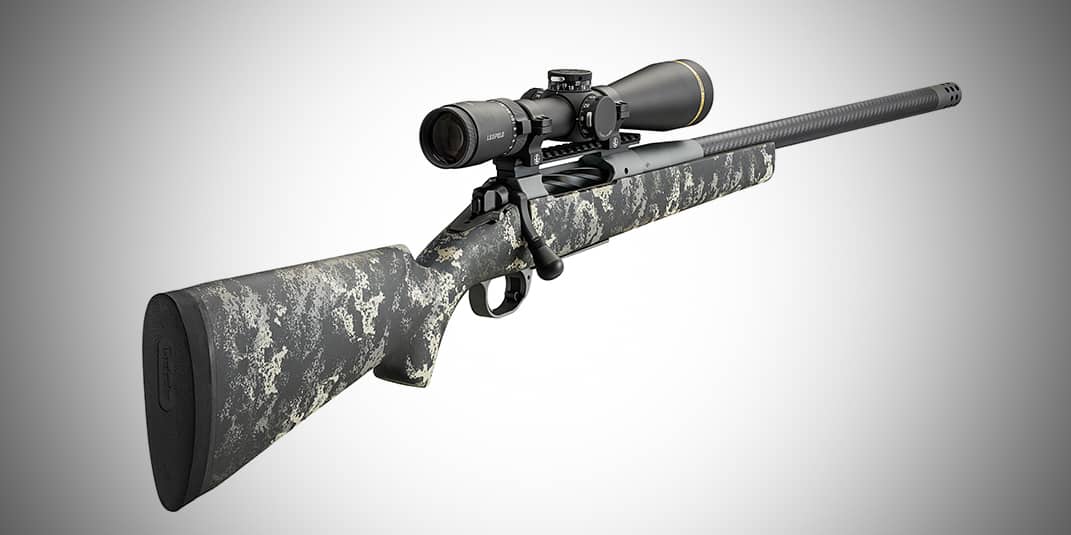
The Waypoint is a wonderful tool, but there’s something to be said for a classic silhouette. Enter the Model Boundary rifle, featuring a hinged floorplate magazine and traditionally shaped stock. I recently had the chance to test and hunt with one chambered in 7mm PRC. The Boundary takes many of the features of their 2020 Waypoint Rifle and mates those up with an AG Composites carbon fiber stock. The AG stock, Springfield Armory 2020 action, carbon fiber-wrapped barrel, a Leupold Mark 5 HD 3.6-18x scope, five rounds of 175 grain Hornady ELD-X ammo along with a Magpul section of Picatinny rail, all combine to weigh just over 9 lbs. (9 lbs., 2.7 oz.) — a range I find imminently suitable for hiking and hunting.
The Details
Everything starts with a stainless-steel action built on a Remington pattern. As good as that rifle was, the Boundary is better. Springfield redesigned the bolt release to a much sturdier type. The recoil lug is machined integral with the action, and they added metal pillars to stabilize the action screws.
Then they partnered with TriggerTech to add in one of their adjustable Field Units. My sample broke like the proverbial glass rod. Note that I do most of my hunting in South Texas. That means being properly dressed in hunting season means a long sleeve shirt to put on over your T-shirt when the sun goes down. I do not generally have to consider the wearing of gloves and what that means to finger sensitivity. That said, the trigger is as easy to make heavier as it is to lighten. Trigger weight can be brought all the way up to 5 lbs. if desired.

Springfield Armory uses electrical discharge machining (EDM) on their actions. The process allows for extremely tight tolerances in very restricted spaces. The end result is a very slick action and a bolt that glides in the raceway. They even do their machining after the metal has been hardened. When I asked about the particulars of that process, an engineer said, “the receiver itself is machined from a pre-hardened solid bar, so that the dimensional accuracy is not diminished after heat treating.”
The two-lugged bolt contained in that receiver is spiral fluted to save a bit of weight and allow debris a place to go where it isn’t in the way. They designed their bolt so that it doesn’t take special made tools to disassemble it — in fact, no tools are required. Just read the manual, then, holding the bolt correctly, compress the shroud about 1/8th inch and push the bolt handle in another ¼ inch. The firing pin and spring drop right out. The bottom metal really is metal and mates up with an integral, internal magazine.

Springfield then spins on a carbon fiber-wrapped barrel. Their process creates a fluted, stainless-steel barrel with a wrap that really only contacts the tube at the front and the rear. Harmonics are enhanced as is cooling. The 24” barrel on my Boundary was capped with both a thread protector and a radial muzzle brake. While loud, the brake works and made it a snap to send a substantial number of rounds downrange when I tested for accuracy — and just a little bit of fun.
Hands On
The net result was a very accurate rifle. I tested six loads including three factory loads from Hornady and three reloads using Hornady and Berger bullets along with Hodgdon and Vihta Vuori powder.
100-yard accuracy was great, but then I got to test it a wee bit farther out. SHOT Show tends to be a family adventure for us and this year was no exception. The most common way back to Houston from Vegas will take you right through Kingman, Arizona and the very nice 1,000-yard range (yep, three zeroes this time) at the Mojave Sportsman’s Club. The range officers are great, the range is very complete, and the scenery is incredible to my crew of flatlanders.
Verifying sight in at 100 yards for my son and me was snap and we progressed through longer distances out to 547 yards. Then we switched to the thousand-yard range. After verifying DOPE at 600, 700 and 800 yards, we got down to work. It took a whole three shots to get our first adjustment at 1,000 yards and a reading on a fishtailing wind. Then we started to pound that 12×16-inch plate. It was great to see consistent hits and enough residual energy to really shove that piece of steel around.

While we were there, my son grabbed his Springfield National Match M1A and started banging away at the 1,000-yard plates as well. With the rear sight sticking up more than an inch about the protective wings, he scared the tar out of those plates a number of times and then connected — with iron sights! How’s that for results from a 35-year-old match rifle?

Of course, the true test of a hunting rifle comes on the hunt. As of this writing, we have been back from a cull hunt in South Texas for less than 24 hours. Here, at the end of the season, our job was to take what I call “trash horns” — spikes and other deer whose racks will never be anything anyone wants to hang up on a wall. Three deer fell with three shots. The first was a spike at 165 yards that did a quick semi-circle and dropped.

The second was a funky 5-point at 187 yards that left a 30-yard trail into the brush, which could have been spotted from outer space. The last was a mature 9-point. The shot measured almost exactly 100 yards (99.3), and he just fell over when hit. He never budged an inch. I was using Berger EOL bullets with Petersen brass, CCI BR2 primers, and Vihta Vuori N565 powder. The combination clocked right at 2,840 fps, and they proved to be just short of magic. I think I know which combination I’ll be hunting with next year.
Conclusion
If you want accuracy and power in a very portable rifle, do yourself a favor and check out the new Springfield Armory Model 2020 Boundary rifle. And we wish you well on your hunt!
Editor’s Note: Please be sure to check out The Armory Life Forum, where you can comment about our daily articles, as well as just talk guns and gear. Click the “Go To Forum Thread” link below to jump in!
Join the Discussion
Featured in this article


Read the full article here