

For the U.S. military, artificial intelligence tools help analysts turn enormous amounts of data into something actionable, like when to strike a target or where to position troops.
The goal, as military officials and industry executives often describe it, is to give commanders the information they need to make consequential decisions as quickly as possible.
But no matter how fast or accurate the analysis is, there’s still a gap between identifying what needs to happen and acting on it. Much of that AI processing happens on computers and servers miles from the battlefield, leaving troops to receive the information through radios, tablets or other devices.
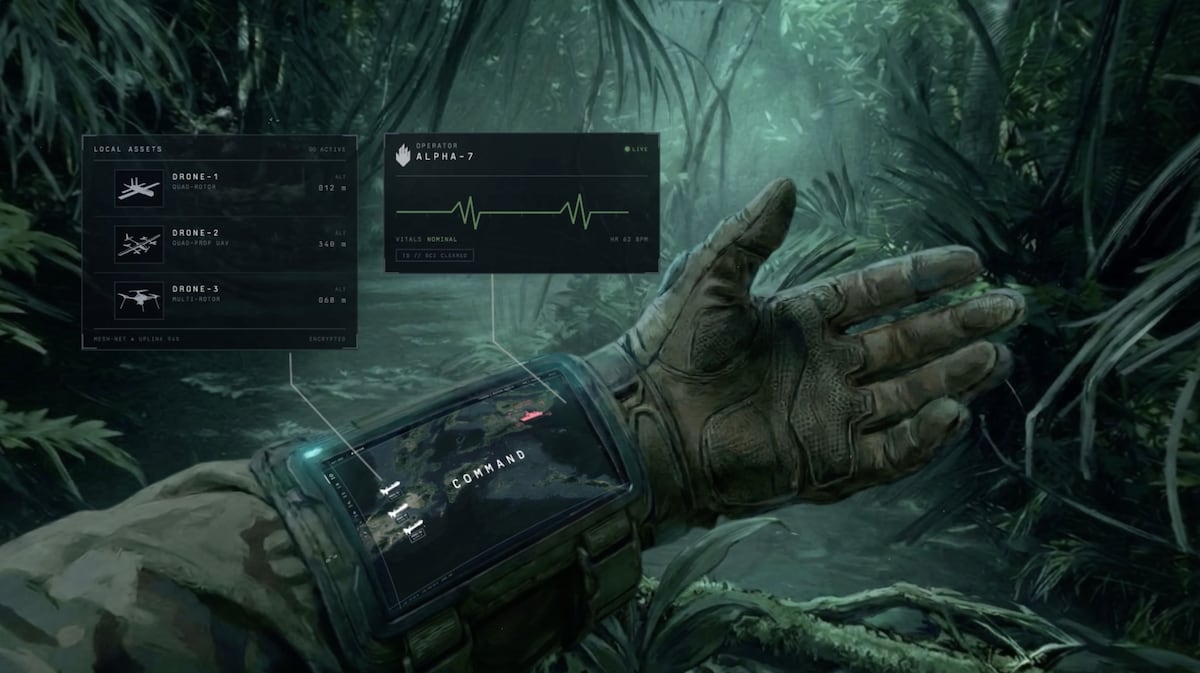
That means the next step in military AI may be putting the technology directly on the bodies of those in the field. While some companies are exploring wearable technology like helmets equipped with heads-up displays, Smack Technologies thinks the answer may be much simpler: Instead of putting AI in a helmet, put it on an operator’s wrist.
The California-based defense tech startup recently raised $61 million in Series B funding to develop Alpha, a wrist-worn device designed to connect operators in the field to real-time data collected and processed through Smack’s Omega AI software.
Andy Markoff, Smack’s co-founder and chief executive, told Military Times that his company started with the software because it could train its AI around day-to-day operations.
“Alpha tackles a much harder problem because you have to make the model work in the field with hardware and little to no connectivity, but we’ve always known this is what has to happen to enable decision dominance,” he said.
During an interview, Markoff walked Military Times through the concept of Alpha, from how operators would wear the device to how it’s used.
As a former Marine Raider, Markoff said he and his team of former military personnel believe the wrist is a more convenient place to access intelligence in the field.
“The form factor we’re building replaces what I literally used to wear on my forearm, only here I’m exchanging a whiteboard and grease pencil for a flexible computer screen that has our models’ capabilities on it,” he said.
He likened the concept to a QB sleeve, which allows a quarterback to see plays at a glance.
“Our sensors that are out collecting information about enemy forces and their location are sending that information to a screen on my forearm along with actionable decision options informed by campaign equities and adjacent units,” he said.
Markoff said he recognizes that a heads-up display could be useful for some missions, but he also sees drawbacks, particularly in hot or humid environments.
“If you’ve ever walked in the jungle at night, you know you’d actually rather risk having an eyeball poked out by a tree than wear shooting glasses that fog up and prevent you from seeing anything,” he said.
However, Markoff said that the hardware is the easy part of building an AI-enabled wearable. The more difficult problem is figuring out what information an operator needs in the field.
He explained the fundamental idea behind Alpha is to decentralize command and control in environments where operators cannot communicate directly with commanders.
“To do this, we’re essentially encoding commander’s intent: here’s our goal, here’s what makes the most sense for the theater and the theater’s goals, and here’s context around how everyone at the front lines should be going after that goal, including constraints and contracts with adjacent units,” he said.
He added that the goal isn’t to have AI make decisions, but to give the operator enough information to make better ones, potentially increasing effectiveness while reducing wasted time and resources.
Alpha has been in development for only about four months, but Markoff projects that Smack will have a working prototype within the next year and could secure contracts for the device within two years.
Daniel Terrill is a contributor to Military Times. He’s been reporting on military issues, the gun industry, and the outdoors for nearly two decades. Although writing is his passion, he’s been a Marine, police officer, and, perhaps the most dangerous job of his career, a substitute teacher.
Read the full article here