

After the fall of Burma (now Myanmar) to the Japanese in 1942, the United States Army fielded a contingent to fight alongside the British and Nationalist Chinese aimed toward getting it back. Although generally outnumbered and handicapped by the mountain, jungle and disease on or over which they had to operate, resourceful units such as the American Volunteer Group, or “Flying Tigers,” and Maj. Gen. Frank Merrill’s 5307th Composite Unit (Provisional), acquired a legendary status for courage and ingenuity that outlived the short time frames in which they actually operated.
Relative obscurity notwithstanding, less famous units, often as temporary as the Flying Tigers and Merrill’s Marauders, did their share of harassing the enemy and reoccupying Burmese territory. One, the 5332nd Brigade (Provisional), also known as Mars Task Force, was among the most unlikely regimental assemblies of World War II.
Consisting as it did of the Redesignated Infantry, the unit largely contained survivors from the Merrill’s sickly but highly experienced fighters; the 1st Chinese Regiment (Separate) and the 124th Cavalry Regiment of the Texas National Guard, activated in 1940 and re-equipped as infantry.
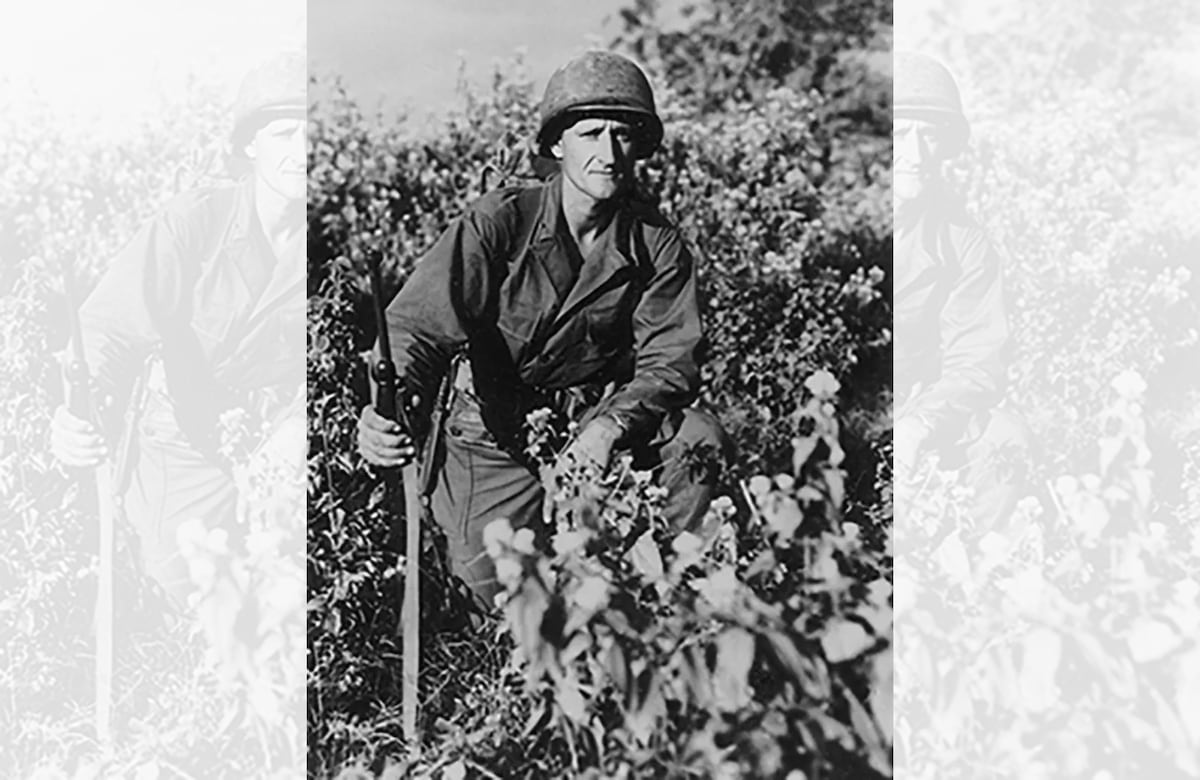
Strange though this fighting trio seemed, it, too, got the job done and one of its officers, 1st Lt. Jack L. Knight, made history as a U.S. Army member to be awarded the Medal of Honor in the China-Burma-India theater.
Born in Weatherford, Garner County, Texas, on May 29, 1917, Knight attended Valley Springs and Garner High School. When war broke out, however, he and two brothers enlisted in the Army at Mineral Wells, Texas, in October 1940 and were federalized in November at Fort Bliss, Texas.
Joining the 124th, Jack enrolled in Officer Candidate School at Fort Riley, Kansas, as did one of his brothers, Lloyd. A third brother, Curtis, declined OCS because he’d just been married. By 1945 Knight had risen to first lieutenant and commanded F Troop of the Mars Task Force, while brother Curtis served as the troop’s first sergeant. Lloyd later commanded a tank destroyer unit.
The force’s objective at that time involved marching 200 miles into northern Burma and cut the Burma Road 30 miles below its junction with the Ledo Road. As the unit advanced through the jungle and mountain terrain, first contact was made with Japanese troops on Jan. 19, 1945, and would continue in and around the area of Loi-kang Ridge over the next 17 days.
At 6:20 a.m. on Feb. 2, the 124th Cavalry advanced 1,500 yards through the Hosi Valley and up a 250-foot slope to take up positions on a strategically vital hill, which they reached in 35 minutes. As they did, Knight reconnoitered ahead and encountered two Japanese soldiers, who he killed with his M1 carbine. He then came upon three enemy pillboxes, at which he threw some of his grenades and then called out to his troopers: “Come on up. There’s a whole nest of them here.”
What Knight’s citation described on his conduct that morning was outstanding even for a battalion full of elite fighters:
Knight “Led cavalry troops against heavy concentrations of enemy mortar, artillery, small-arms fire, after taking the troops’ objective and while making preparations for a defensive, he discovered a nest of Japanese pillboxes and foxholes to the right front, preceding his men by at least 10 feet. He immediately led an attack, single-handedly he knocked out two enemy pillboxes and killed the occupants of several foxholes.”
While he was attacking out a third pillbox, a Japanese grenade landed in front of him. Although he stepped back, he was wounded by it. In spite of that, he rallied his platoon and told one of his officers, 2nd Lt. Leo C. Tyson, to bring up more ammunition. He then continued leading the assault on a fourth pillbox, which he engaged with a grenade and his carbine.
As he did, a Japanese soldier rushed him with his bayonet, but Tyson arrived back in time to kill Knight’s assailant. By then some of F Troop saw blood dripping down his face and even as he joined in the attack, he intimated to Tyson, “I can’t see.”
In spite of that, Knight was crawling up toward the enemy when a second grenade mortally wounded him. His brother, 1st Sgt. Curtis Knight tried to take charge, but was struck by a bullet under his heart. Miraculously, he survived the wound and the war.
After 17 days of fighting, Mars Force’s objective was secured on Feb. 5. Both the Burma and Ledo roads were securely in Allied hands. Leo Tyson later received the Silver Star for his performance in the struggle. As for Jack Knight, his contribution was concluded in his citation: “First Lieutenant’s Knight’s gallantry and intrepidity were responsible for the successful elimination of most of the Japs’ positions and served as an inspiration to officers and men of his troop.”
After learning of his actions, the commander in chief of the CBI, Lord Louis Mountbatten, named the site of F Troop’s late commander’s last fight “the Battle of Knight’s Hill.”
On June 6, 1945, Knight posthumously was awarded the Medal of Honor, which Maj. Gen. Bruce Magruder presented to the lieutenant’s father, Roy Knight, at Camp Wolters, Texas, on June 25. Knight’s remains now lie in Holders Chapel Cemetery in Cool, Texas.
Read the full article here