

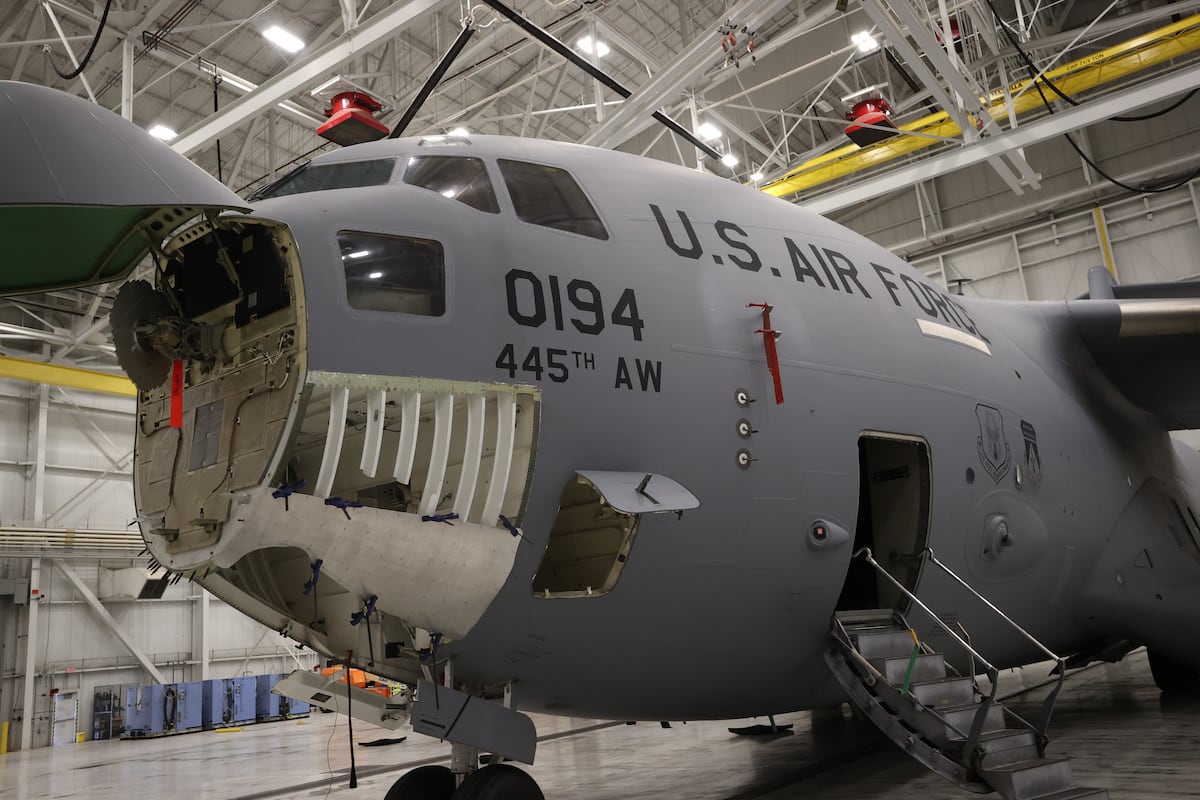
A C-17 Globemaster III that was facing two years out of service is airborne again after the U.S. Air Force built a replacement part itself, using a robot.
The airlifter, tail number 01-0194, assigned to the 445th Airlift Wing at Wright-Patterson Air Force Base, Ohio, was parked overnight at Perot Field Fort Worth Alliance Airport in Texas on March 4, 2025, when severe storms and microbursts of up to 80 mph sent two private Bombardier Challenger jets careening into it.
Video shot that morning showed one of the business jets come to rest beneath the C-17’s wing. The same storm system damaged numerous aircraft at airports across the metroplex.
The collision damaged the C-17’s left-side door, fuselage and nose. The crew flew it home with a Boeing-qualified and Air Force-approved temporary nose panel and landing gear down.
Back in Ohio, maintainers repaired the door and fuselage but determined the left nose panel had to be replaced, which is where the job stalled.
Boeing was unable to find a vendor willing to build tooling for a single nose panel, according to the Air Force. After an unsuccessful repair attempt, the jet was looking at a year in storage followed by another year of repair work, sidelining one of only nine C-17s the wing counts as mission-essential.
The wing turned to the Air Force Rapid Sustainment Office (RSO), a Life Cycle Management Center division at Wright-Patterson that hunts for ways to fabricate parts the supply chain can’t deliver.
Engineers there deemed the panel a good candidate for incremental sheet forming, or ISF, in which a robot presses a flat metal sheet into shape a little at a time. Because the machine follows a digital path rather than a mold, tooling is unnecessary.
Working with the University of Dayton Research Institute, the team began production in January 2026. Boeing, along with maintainers from the wing, installed the finished panel in July, and 01-0194 took to the skies again July 30, nearly 17 months after the storm.
“This is a tremendous win for our maintenance group,” Col. Karen Gharst, the 445th Maintenance Group commander, said in a statement. “Using the ISF technology to rapidly produce an otherwise unobtainable part allowed us to avoid a prolonged work stoppage.”
The event marks the first incrementally formed part to fly on an Air Force aircraft.
Boeing closed the C-17 line in 2015, and the Air Force expects to fly the fleet into the 2070s, meaning this may not be the last time the service has to hunt for parts nobody makes anymore.
The RSO is currently working on parts for a KC-135 and an F-15.
Michael Scanlon is a defense journalist covering air and space warfare. A former U.S. Air Force A-10 crew chief, he has supported land and sea programs for the U.S. Army, Navy, Marine Corps and Coast Guard.
Read the full article here