

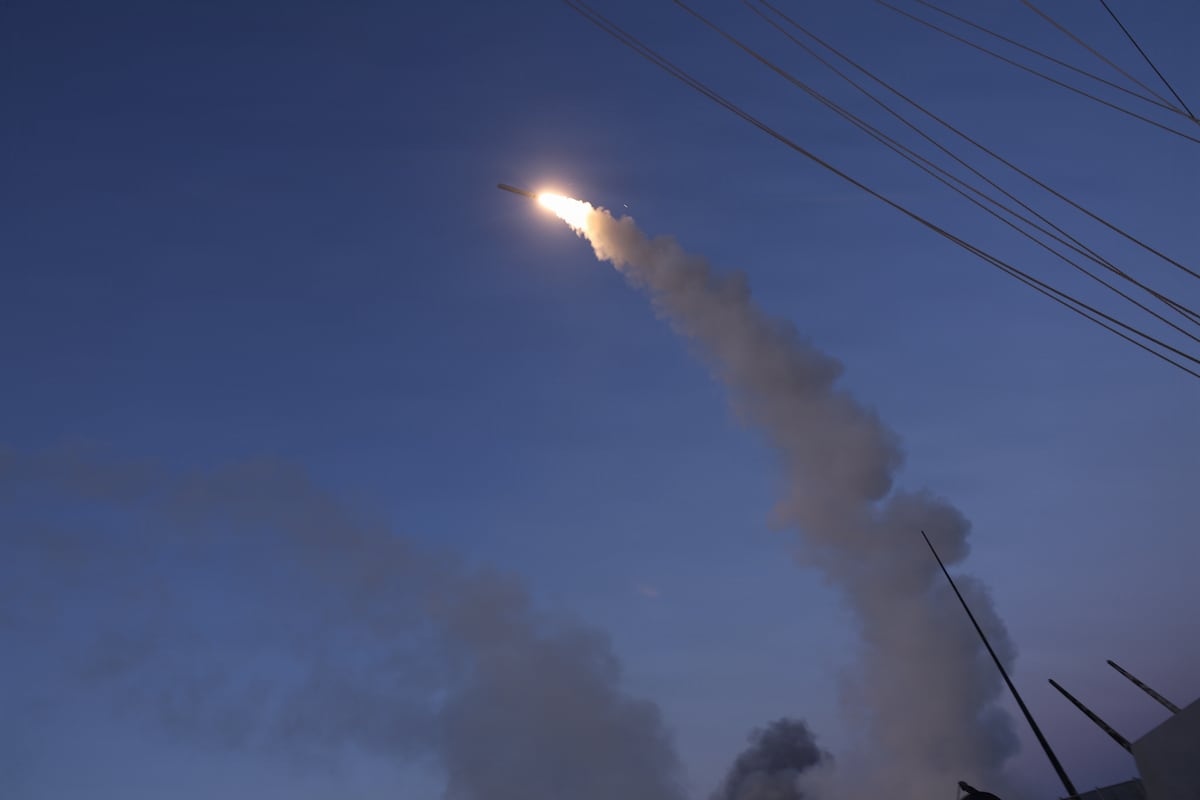
MANILA, Philippines — The Japanese destroyer JS Chokai is now capable of launching U.S. Tomahawk cruise missiles, making it the first Japanese warship that can strike targets beyond 1,000 kilometers.
This development marks a key shift in the country’s defense strategy. Japan committed to acquiring 400 Tomahawks last year to equip its eight Aegis destroyers as part of a larger standoff capability, which includes fielding upgraded Type 12 missiles in the southwest and deploying hyper velocity gliding projectile systems across the country.
The existing missile defense network may not be fully capable of responding to threats, Defense Minister Shinjiro Koizumi told reporters in a briefing on Friday.
“To prevent missiles flying through the missile defense network and to prevent further armed attacks, it is necessary to … have the ability to counterattack. Stand-off missiles can also be used for this counterattack ability,” Koizumi said.
The destroyer’s launcher modification marks a landmark milestone in the country’s efforts to rapidly deploy stand-off capabilities and bolster deterrence measures, he added.
Stand-off weaponry describes a class of ams with ranges so long that operators can fire them from a safe distance, without fearing countermeasures capable of reaching them.
The defense ministry introduced stand-off capabilities in 2017, and it formed the core of the security strategy shift in 2020, which later expanded to additional policy documents, including a detailed buildup plan in the country’s southwest in 2022.
The Tomahawk cruise missiles can be launched from ships or submarines with a range of over 1,600km. The Japanese variant can be rerouted during flight, and advanced versions are capable of hitting moving targets.
The refitted JS Chokai can load and fire both the Block IV and V variants of the cruise missiles.
JS Chokai arrived at Naval Base San Diego, California, in October 2025 for renovations and crew training with the U.S. Third Fleet. Live-fire training is scheduled for August, before JS Chokai returns to its home port in Sasebo Naval Base in the southwestern Kyushu Island in September.
Japan is moving toward a “denial and limited strike” model by fast-tracking the implementation of its 2022 strategy, maritime security expert Benjamin Blandin told Defense News. Blandin is a research fellow at the Institute for National Defense and Security Research in Taiwan.
“Japan is operationalizing a long overdue counterstrike capability, shifting from strict homeland defense to semi-regional deterrence by being able to strike ground and naval targets at up to 1000 km,” Blandin said.
Japan’s existing defense force, including its stand-off missile capability, is the “minimum necessary for self-defense,” Koizumi said, adding that these would only be used “in the event of an armed attack from another country … and it does not pose a threat to other countries.”
Analysts have raised worries that the U.S. Tomahawk stockpile may be strained after reports indicated that over 800 missiles were used in four weeks during Operation Epic Fury against Iran, and this might impact missile orders for allies, including Japan.
Blandin said Japan’s Tomahawk orders are unlikely to be affected immediately, but prolonged military campaigns in the Middle East could cause minor to moderate setbacks.
American manufacturer RTX, in a Feb. 4 press release, said it had signed five agreements with the U.S. Department of Defense to boost production and expedite deliveries of Land Attack and Maritime Strike variants of the Tomahawk cruise missiles, with annual production expected to increase to more than 1,000.
“No major impact expected in regards to Iran, as deliveries will not take place all at once but probably over the course of a few years,” Blandin said. “In any case, the U.S. will likely prioritize Japan as a key Indo-Pacific ally.”
Leilani Chavez is an Asia correspondent for Defense News. Her reporting expertise is in East Asian politics, development projects, environmental issues and security.
Read the full article here