

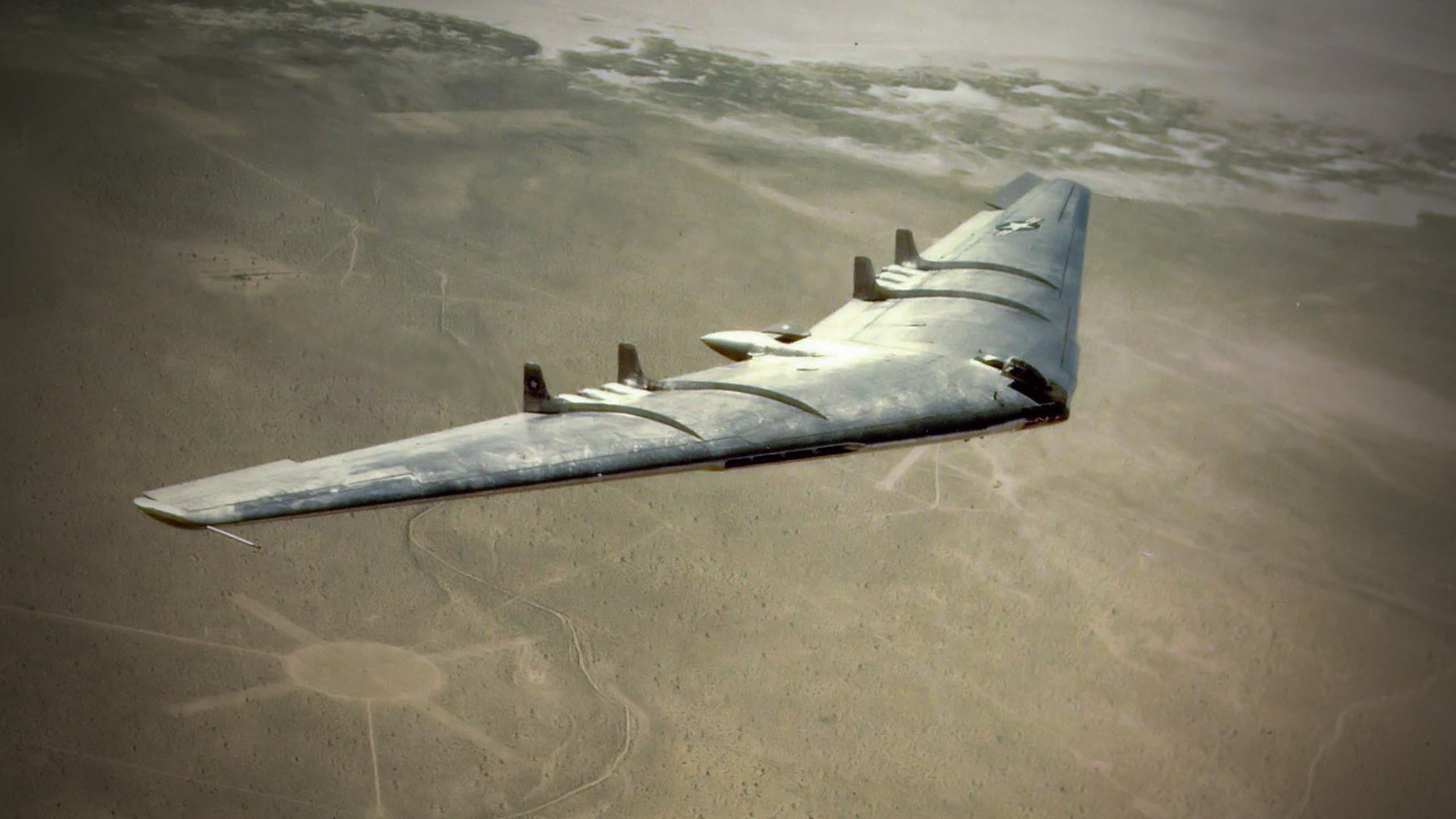
From its earliest experimental roots to today’s cutting-edge stealth bombers, the flying wing has remained one of aviation’s most radical and enduring ideas. Stripped of traditional fuselage and tail structures, this design prioritizes aerodynamic efficiency above all else. The design reduces drag and saves weight, which can extend its range.
What began as a bold engineering concept in the 1930s would go on to influence some of the most advanced military aircraft ever built, including Sixth Generation stealth bombers and unmanned support and combat aircraft.
Horten Ho 229
The Ho 229 was the first flying wing design to take to the skies. Design began in 1943 in response to the Luftwaffe Chief Hermann Göring’s request for a light bomber that met the 3×1,000 requirement. The bomber had to carry a payload of 1,000 kilos, 1,000 kilometers, at a speed of 1,000 kilometers per hour. This type of speed could only be achieved using jet propulsion.

Since jet engines used more fuel than propeller engines, the design of the aircraft had to be extremely fuel-efficient to meet the requirements, and the Horten brothers, Reimar and Walter, favored the flying wing design for its aerodynamic efficiency.
The brothers had experience with the flying wing design in the 1930s, building gliders as Germany was prohibited from building military aircraft due to the Treaty of Versailles.

The Ho 229 was constructed with a steel tube center section with an outer wing box spar made of pine. The outer wings were skinned with plywood panels that were glued together with a sawdust mixture.
In March 1944, the V1 prototype, a glider tested by the Horten Brothers, was approved. The design and manufacturing responsibility was transferred to the Gothaer Waggonfabrik, as the Hortens did not have the facilities for mass production. After the transfer, design changes were made due to the addition of the Junkers Jumo 004 turbojet engines. Ducting was added to cool the outer casing of the engines and prevent damage to the wooden portions of the aircraft. Other changes included the addition of a crude ejection seat and a redesigned undercarriage.

The V2 Jumo-powered prototype took its first flight in December 1944, but during a February 1945 test flight, the prototype crashed, killing the pilot and destroying the aircraft. A V3 prototype was nearly completed, but was too late to support the German war effort.
In April 1945, Patton’s Third Army captured four Horten prototypes, and the V3 was transported to the United States under Operation Paperclip for evaluation. This aircraft is currently undergoing restoration at the Smithsonian Air and Space Museum.
Northrop YB-35
In the 1930’s, Jack Northrop was focused on the flying wing concept, advocating the design as a way to reduce drag and weight. Just before World War II, Northrop and Consolidated Vultee Corp, later known as Convair, were tasked with the design of a large wing bomber that would carry 10,000 pounds of payload, have a round-trip capability of 10,000 miles, a cruising speed of 275 mph with a top speed of 450mph, and a service ceiling of 14,000 feet. The purpose was to create a bomber that could strike Germany from the United States if Great Britain were conquered.

In November 1941, the contract was signed for the XB-35 with an option for a second, and early design work began in 1942. As the flying wing has no tail or rudder, it uses a double split combination flap/aileron dubbed the “Flaperon” on the trailing edge of the wingtips to steer the aircraft.
The bomber was equipped with a crew cabin with folding bunks, a tail cone with remote sighting stations for the gunners, and three bomb bays in each wing section. It also took advantage of a new aluminum alloy produced by Alcoa that was lighter and stronger than the previous product.

The first flight was in 1946 and went successfully. Future flights, however, had issues with the counter-rotating propellers that increased vibrations with each flight. The engines and propellers were the property of the Air Force, and no one would take responsibility for the issue. Tired of the bureaucracy, Jack Northrop grounded the aircraft until the government fixed the problem.
The government then ordered Northrop to convert two airframes to jet propulsion using eight jet engines. The engine change resulted in significantly improved performance, albeit at the cost of range due to increased fuel consumption. Since the range was cut in half, the bomber did not qualify for its new post-war focus of strikes on the Soviet Union.

The project was finally cancelled after subcontractor Glenn L. Martin Company said they couldn’t deliver the first aircraft until 1947. The Air Force Technical Command then took over the program for research.
Northrop YB-49
With the XB-35 program ended, the flying wing program continued as the YB-49, with the two airframes converted to jet engine power. The first flight of the prototype happened on October 22, 1947, from the Northrop facility in Hawthorne, California, to Muroc Field and set an endurance record of 6.5 hours above 40,000 feet.

On February 9th, 1949, prototype #1 flew from Muroc AFB to Andrews AFB in Washington, D.C. in 4 hours 25 minutes. President Eisenhower then ordered a flyby of Pennsylvania Avenue at rooftop level. The flight back to Edwards was almost disastrous when four of eight engines had to be shut down, forcing a landing in Winslow, Arizona. The cause of the engine failures was oil starvation. It seems the oil was not topped off before leaving Andrews, sparking more suspicion of industrial sabotage.
On June 5th,1948, tragedy struck when the #2 aircraft crashed during a stall test, killing Pilot Major Daniel Forbes (Forbes AFB), co-pilot Glen Edwards (Edwards AFB), and three other crew members. The aircraft was lost when it went into a high-speed nose-over dive, suffering structural failure, and the outer wings snapped off.

In 1950, the surviving prototype suffered a fire after a high-speed taxi test procedure collapsed the nose gear. The aircraft had a full load of fuel, which was unusual for this type of test, and was destroyed by fire, which added to the rumors of sabotage.
However, the program continued as the YRB-49A, a reconnaissance version. It was powered by six jet engines with two mounted in underwing pods. Although there were contracts for the YRB-49A, all YB-35 airframes slated for conversion were ordered scrapped, and in May of 1950, the entire program was cancelled by the Secretary of the Air Force, Stuart Symington.

In one last insult to Northrop, portable smelters were brought onto the Northrop factory, and except for the single YRB-49A prototype, all flying wing airframes and tooling were melted down in front of the employees.
The sole reconnaissance prototype made its last test flight in April 1951 and was flown to the Northrop facility. There it sat abandoned until December 1953, when it was ordered scrapped.

Live The Armory Life. The latest content straight to your inbox plus an automatic entry to each of our monthly gun giveaways!
Strange requirements and testing procedures plagued the program, as well as indifference by the Air Force and backstabbing by the Secretary of the Air Force, Stuart Symington. Symington met with Jack Northrop and told him that he had better merge with Convair, or you’ll be “Goddamn sorry if you don’t.”
In a 1979 interview, Jack Northrop himself stated the program was cancelled because Northrop refused to merge with Convair. Before he died in 1981, Jack Northrop’s company bid for the new flying wing stealth bomber, known as the B-2. He stated, “I know why God has kept me alive for the past 25 years.”
Northrop B-2 Spirit
Development of the Northrop B-2 Spirit stealth bomber began under the Advanced Technology Bomber Program during the Carter administration. Its main selling point was its stealth capabilities. The B-2 is capable of flying more than 10,000 miles with one midair refueling. Officially, it has a 40,000-pound weapons load capacity, but was recently used to destroy Iranian nuclear weapons development sites using two GBU-57 Massive Ordnance Penetrators, which weigh 30,000 pounds each.

Based at Whiteman AFB, MO, with detachments at Anderson AFB, Guam and Diego Garcia, the B-2 has flown combat missions into Bosnia, Afghanistan, Libya, Yemen and Iran. Originally, Northrop was to build 132 units. Still, high costs, the end of the Cold War, and the breakup of the Soviet Union brought the number down to 21. Of those 21, 19 are in service after a 2008 crash and burn at Anderson, AFB, and a 2022 crash at Whiteman AFB, where the aircraft’s left landing gear collapsed, causing significant damage, and the Air Force deemed it too expensive to repair.

Northrop Grumman B-21 Raider
The B-21 was conceived as part of the Long-Range Strike Bomber program, begun in 2011. The program was tasked with creating a stealth intercontinental strategic bomber for the U.S.A.F., able to deliver conventional and nuclear weapons. The Request For Proposal was issued in July 2014, and Northrop was awarded the contract in October 2015.

The Raider is smaller than the B-2, with a 20,000-pound weapons load capacity (officially). It cruises at 50,000 feet and has a top speed of Mach 0.8. While its primary mission is as a bomber, the B-21 was also designed to be an intelligence collection platform and a battle manager.

It was designated the B-21 as it’s the 21st century’s first bomber, and named “Raider” in honor of the Doolittle Raiders. The B-21 is intended to replace the 45 remaining Rockwell B-1B Lancer bombers, aka “The Bone,” the 19 remaining B-2 Spirit bombers, and 72 B-52 bombers, although I wouldn’t count on that. The BUFF refuses to die and will probably be escorting the B-21s to the boneyard in 2075!

The U.S.A.F. is expected to operate a fleet of at least 100 B-21’s, stationed at bases that already host heavy bombers.
Future of the Flying Wing
Although the flying wing concept has been around for almost 100 years, the design is not going anywhere soon. The technology is used for blended wing-body designs for commercial aircraft, and the U.S. Navy and other military services are operating flying wing drones, as well as hostile foreign actors. Consider, for example, the U.S. Navy’s X-47B.

The Northrop Grumman X-47B marked a major step in bringing the flying wing into the unmanned, carrier-based era. Developed for the U.S. Navy’s UCAS-D program, it combined a stealthy, tailless design with advanced autonomy, allowing it to perform complex flight operations without a pilot.

In 2013, the X-47B made history by autonomously launching from and landing on the USS George H.W. Bush (CVN-77). It also proved capable of autonomous aerial refueling, showing how unmanned systems could integrate alongside manned aircraft. Though only a demonstrator, the X-47B helped pave the way for operational platforms like the MQ-25 Stingray and other carrier-based drones.

Recently, a large flying wing aircraft, the identity of which is unknown, whether manned or unmanned, was spotted near the secretive Malan air base in the Xinjiang province, China. It appears the flying wing design will be well represented in the future.
Editor’s Note: Please be sure to check out The Armory Life Forum, where you can comment about our daily articles, as well as just talk guns and gear. Click the “Go To Forum Thread” link below to jump in!
Join the Discussion
Read the full article here