

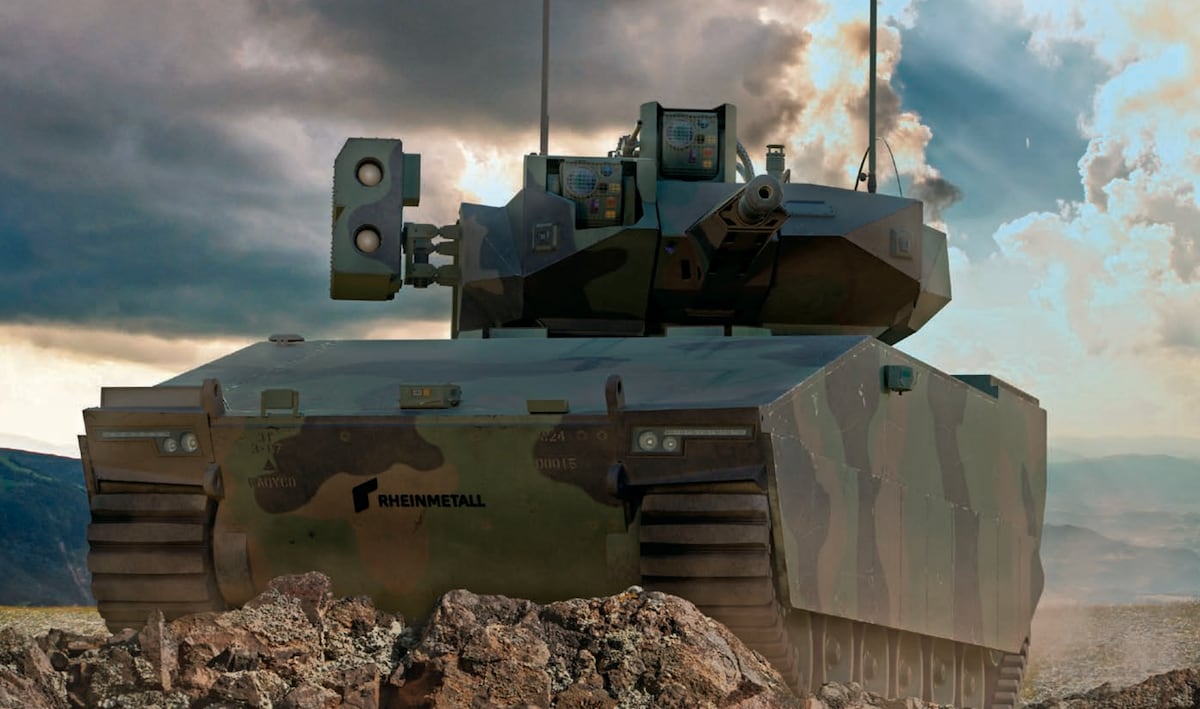
One of the U.S. Army’s next-gen combat vehicle prototypes is finally being seen and operated by the service members who will one day steer the final product.
American Rheinmetall, one of two defense companies chosen to develop replacements for the Army’s M2 Bradley Fighting Vehicle, announced in September the delivery of its Lynx XM30 prototype to the service. The Army conducted initial safety tests before allowing soldiers to join the trial-and-error phase.
“Now it’s in soldiers’ hands,” said Chris Haag, vice president of business development and strategy at Rheinmetall. “Seeing their eyes light up when they got to see the vehicle for the first time is pretty awesome.”
While Haag could not disclose where soldiers were along the tinkering process, he confirmed that service members were in possession of the vehicle and were at least able to hop inside and turn it on, beginning a new era for Army combat vehicles.
Rheinmetall is currently competing for the XM30 Army contract with General Dynamics Land Systems, which is unveiling its Wolf XM30 prototype at the Association of the U.S. Army Annual Meeting and Exposition in Washington, D.C., from Oct. 12 to 14.
The Army selected the companies in 2023 for the design phase of a process that will eventually replace the Bradley, which arrived in the 1980s.
The Lynx XM30 is designed for modern combat environments riddled with drones and electronic warfare, like those seen in Ukraine.
The vehicle will wield a hybrid-electric powertrain and an uncrewed 50mm turret, providing more firepower than the Bradley, which boasts a 25mm M242 Bushmaster.
American Rheinmetall’s prototype likely wouldn’t differ from General Dynamics’ XM30 design when it came to physical architecture, Haag said, which meant the Lynx could differentiate itself from competition through aspects like power, engine, transmission and soldiers’ experience with user interface and operability in general.
The Army’s initial solicitation called for a new combat vehicle shaped by a modular, open architecture, which will allow it to undergo updates more swiftly than its predecessor.
For large modernization efforts, the M2 Bradley Fighting Vehicle may have to travel back to an Army or manufacturing facility to undergo overhauls or block upgrades, whereas the XM30 could potentially undergo software updates that revamp the system in a much shorter timeframe and require less geographical displacement.
The company will deliver seven more prototypes to the Army by the end of the year, all part of a nearly $764 million Engineering and Manufacturing Development contract to expand the XM30 from digital design through validation.
Regarding next steps, Haag said the Army will put the prototype through testing and evaluation with soldiers, driving it hundreds of miles to see what works and what doesn’t.
The service will then provide feedback to American Rheinmetall, at which point the company can incorporate those suggestions into updated designs that it will use to try to nail down a final contract.
Riley Ceder is a Navy reporter at Military Times, where he covers issues directly affecting service members and their families, as well as breaking news.
Read the full article here