

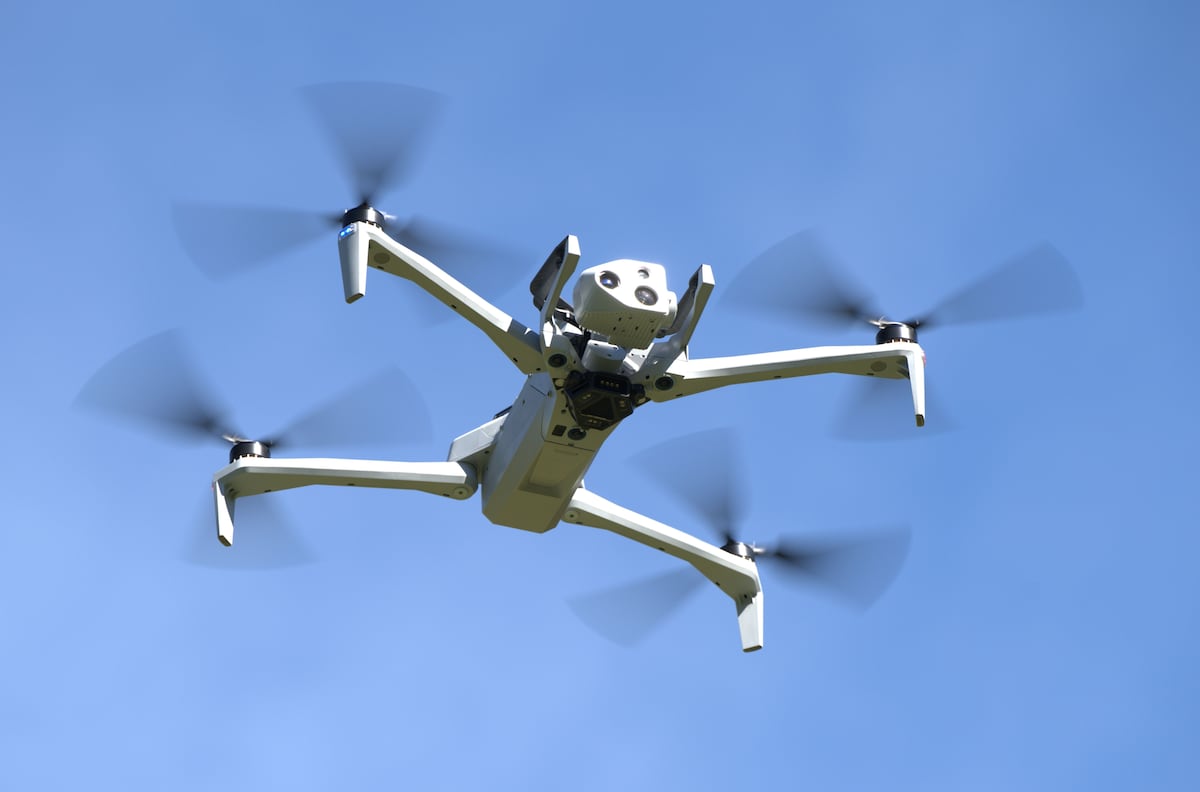
The U.S. Air Force certified a team of special agents to operate small autonomous systems, or sUAS, in an effort to improve the drone’s system operations across the service.
In a first, the Air Force Office of Special Investigations has certified the group to operate and instruct others on the Skydio X10D, with the model able to assist missions that need “an eye in the sky,” according to a Tuesday release.
Six personnel completed a weeklong course at the office’s headquarters in Quantico, Virginia, making up the first group of instructors able to bring back the capability to technical operation units in the field, the statement reads.
“We not only learned how to operate the drones, but also how to properly instruct other individuals on how to fly successfully to meet mission needs,” Special Agent Logan Trigg, assigned to the 2nd Field Investigations Squadron Technical Operations Program, said in the announcement.
Trigg will now train the entire 2nd FIS on drone operations in order for all agents to be certified, ensuring the ability to “attack the mission effectively.”
With the “train-the-trainer” model, the Office of Special Investigations aims to grow the program so the capability can support surveillance, outdoor crime scene, protective-service support and other operations that need aerial monitoring.
The course at Quantico required agents to complete about 16 hours of classroom instruction that included topics such as airspace, Federal Aviation Administration requirements and mission planning. Then it led to roughly 16 hours of flight scenarios around the AFOSI mission, which included one exercise in which a student lifted the aircraft to roughly 400 feet to identify a vehicle’s license plate and track it for a mile.
Another exercise used the aircraft’s thermal camera at night to find a person hidden in a wooded area.
AFOSI began working on this capability in 2024 with Detachment 111 at Edwards Air Force Base, California, which served as the working pilot program.
“Det. 111 helped establish the proof of concept for a broader expansion,” Special Agent Scott Zawacki, AFOSI Technical Operations program manager, said in the release.
Although the technology hasn’t been used in a real AFOSI case yet, demonstrations are showcasing how it can best support field operations like crime scene documentation, reconnaissance and spatial data capturing.
Five X10Ds are slated to be used by technical operations agents in January 2027, according to the release.
Cristina Stassis is a reporter covering stories surrounding the defense industry, national security, military/veteran affairs and more. She previously worked as an editorial fellow for Defense News in 2024 where she assisted the newsroom in breaking news across Sightline Media Group.
Read the full article here