

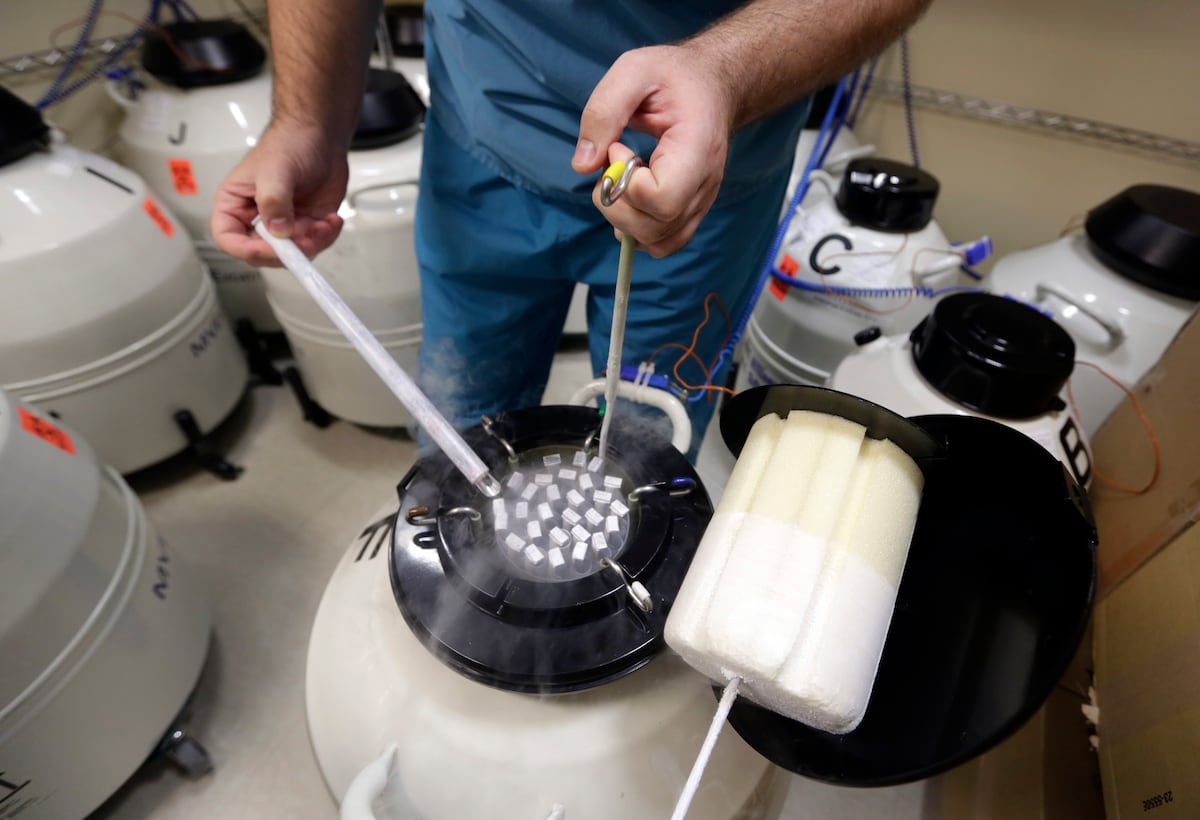
The Pentagon will soon cover the cost for service members to freeze their sperm or eggs before they deploy to a danger zone or are separated from their significant others for more than six months on orders.
In a notice expected in the Federal Register on Thursday, the Defense Department will launch a three-year pilot in September that will reimburse eligible troops to preserve their gametes before deployment.
The benefit, required under the fiscal 2025 National Defense Authorization Act, will pay service members up to $500 per year for sperm retrieval and cryopreservation and $10,000 per year for egg preservation services.
Those eligible include active-duty DoD personnel who receive orders qualifying for hazardous duty pay, those who expect to get such orders within 120 days and those geographically separated from a “spouse, domestic partner or dating partner” for 180 days or more.
Military families and family planning advocates have lobbied for more than a decade to increase access to fertility services, to include cryopreservation of sperm and egg cells before combat deployments, in vitro fertilization and other advanced reproduction treatments.
In 2014, the Bob Woodruff Foundation sponsored a one-of-a-kind, two-day conference on intimacy and family issues among the combat injured that highlighted the need among wounded personnel to have broader access to family planning counseling, gamete banking and fertility treatments.
Nearly 2,000 troops received debilitating injuries to their groins or genital regions between 2000 and 2013, and 307,000 service members experienced some type of head injury during the same time frame — injuries that sometimes can affect fertility and sex drive.
RELATED
In 2016, then Defense Secretary Ash Carter announced that the Pentagon would begin covering sperm and egg freezing for service members, but the planned pilot never came to fruition following the election later that year of President Donald Trump.
Military families have often spent their own money on cryopreservation as a safeguard, and in extreme cases, have paid to extract sperm from dying loved ones to ensure the possibility of advanced reproductive services.
In 2019, the parents of West Point Cadet Peter Zhu extracted their son’s sperm after he was fatally injured in a skiing accident. They argued in court that Zhu had expressed wanting to have a family someday, and they wanted to preserve his sperm to provide future options.
In Israel, since the start of the Gaza conflict, the military has started offering the option to retrieve the sperm of deceased service members when delivering casualty notifications, according to The New York Times.
Since at least 2022, organizations such as the Military Family Building Coalition, Resolve: The National Infertility Association and others have provided free cryopreservation services to some service members, but until now, no government assistance has been available for deploying troops.
How the program works
Under the pilot, service members can elect to obtain preservation services at a military treatment facility that offers reproductive programs or through a civilian clinic of their choice.
Commanders must validate eligibility, as the Defense Health Agency does not have access to orders. To receive reimbursement, eligible troops must have written affirmation from their commands.
Reimbursement must be requested within 120 days after covered services began — usually the date of retrieval, prescription or lab procedure. Troops must submit itemized invoices and DHA Form 459.
Service members could be eligible for the program more than once within the three-year pilot. Any decisions regarding continued storage, disposition or later use following participation “are solely the responsibility of the covered member and outside the scope of the program,” according to the announcement.
Throughout the pilot, the DoD plans to study the program’s popularity, its cost, continued feasibility and impact on readiness, according to the announcement.
More information on the benefit will be available in the Aug. 13 edition of the Federal Register.
Patricia Kime is a senior writer covering military and veterans health care, medicine and personnel issues.
Read the full article here