

Mold, asbestos and crumbling walls are only some of the issues plaguing the U.S. military’s Pacific bases, according to a Pentagon watchdog.
At Camp Courtney and Kadena and Yokota Air Bases in Japan, investigators with the Defense Department Office of Inspector General found “visible corrosion, visible mold, visible fire damage, visible cracks on the building exterior and interior, visible concrete spalling and exposed rebar, water intrusion, lead‑based paint, asbestos‑containing material and inoperable communication connections.”
The findings came during an audit of Pacific Command infrastructure, during which IG investigators visited 11 PACOM bases in May 2025. They examined operations and communications infrastructure, as well as base housing.
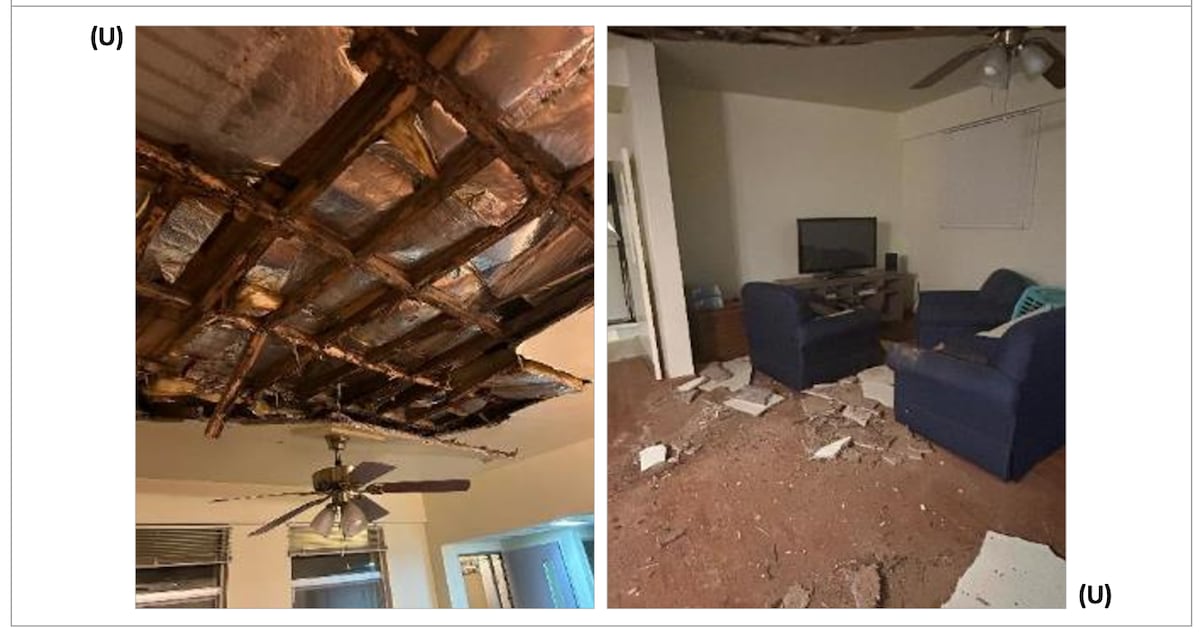
Though the report is heavily redacted, the descriptions — and the photographs — show some structures on the verge of collapse, including two photos of homes at Kadena with crumbling ceilings and living room furniture strewn with debris.
“DoD officials told us that in some areas, falling debris — ranging from small fragments to large slabs — poses an ongoing risk to personnel safety,” the report states.
The audit was originally aimed at assessing the state of “mission-critical systems,” such as operations and communications infrastructure. Investigators determined that housing and water infrastructure are “critical to support the Service members in the USPACOM AOR as they complete their mission.” Their examination of those facilities revealed numerous problems.
Photos of a 50-year-old pier at Camp Courtney show corroded steel fenders and damaged concrete beams.
One Kadena building had eight inches of standing water on the roof, asbestos and cracked pillars and walls.
A Kadena aircraft hangar had holes in the walls.
A 50-year-old water pipe at Kadena had a 12-foot crack. Broken pipes at Kadena and Yokota have caused flooding and collapsed sidewalks.
At Kinser Tower base housing at Kadena, concrete damage has affected 544 homes, according to the IG.
Sebille Manor Housing at Kadena received 100 reports of mold, and dozens of Kadena residents were forced to move due to mold and concrete concerns.
DoD officials told IG investigators that “aging infrastructure, construction choices, or environmental conditions caused accelerated degradation.” In addition, facilities in Japan experience the effects of typhoons, earthquakes and tsunamis.
DoD officials also blamed the problems on a lack of funds and the high cost of services in places like Japan.
They said that while the Japanese government provides host-nation funding, often it can’t be used to fix infrastructure. Instead, these funds tend to be allocated to new construction, or to “broader strategic objectives, such as reducing the impact of U.S. forces on the people of Okinawa.”
The IG recommended that various base commanders in mainland Japan and Okinawa submit a list of priority repairs. But this raises some interservice issues. For example, Army officials said that while Fort Buckner is used only by Army units, the Marine Corps is the real property owner.
The IG also recommended that the secretaries of the Army, Navy and Air Force — as well as the commanders of PACOM and U.S. Forces Japan — conduct a root-cause analysis of infrastructure problems and find funding to fix them. The Deputy Assistant Secretary of War for Infrastructure Modernization and Resilience concurred with the IG’s recommendations.
Dilapidated military facilities are not confined to the Pacific. A 2022 Government Accountability Office report estimated an infrastructure maintenance backlog of $137 million as of 2020. Housing on military bases in the United States has long been afflicted by issues like toxic mold.
Michael Peck is a correspondent for Defense News and a columnist for the Center for European Policy Analysis. He holds an M.A. in political science from Rutgers University. Find him at theuncommondefense.com. His email is mikedefense1@gmail.com.
Read the full article here