

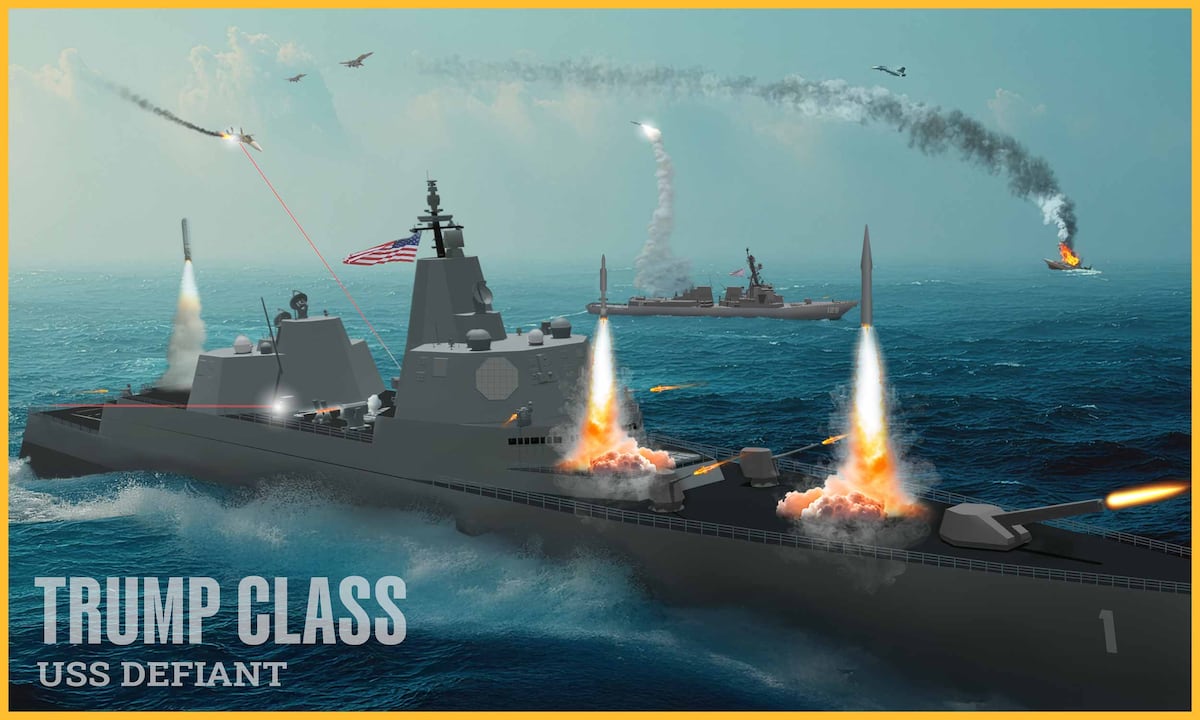
The potential cost of the Navy’s new nuclear-powered battleship procurement program is estimated to be an eyewatering $275 billion, with the first Trump-class battleship (BBG(X)) costing $23.4 billion, according to a Congressional Budget Office report published Wednesday.
The Trump administration in December announced its intention to build a new class of large surface combatants, designated as the Trump-class guided missile battleship.
If built, the 35,000-ton nuclear battleship, according to the report, will be the most heavily armed surface vessel the U.S. Navy has ever built, possessing anti-air, land-attack and anti-ship missiles, hypersonic missiles, nuclear cruise missiles, large lasers and a rail gun.
“If built to those specifications, the ship would be the largest surface combatant in the world and larger than any surface combatant built for the Navy since World War II,” according to the report. “It would be more than three and a half times the size of the Navy’s Arleigh Burke-class guided missile destroyer and more than twice the size of the Zumwalt-class guided missile destroyer.”
The Navy projects that between 2028 and 2056 it will build 15 Trump-class guided missile battleships, with the subsequent 14 costing $18 billion each. By contrast, the USS Gerald R. Ford, the U.S. Navy’s premier nuclear-powered aircraft carrier, cost approximately $13.3 billion.
By 2058, the total tonnage of “large surface combatants to be constructed would need to increase by 60 percent,” which the report notes “could be a challenge for the shipbuilding industry.”
The shift away from small surface combatants would mean that by 2035, shipyards would need to produce 12% greater tonnage under the 2027 plan than under the 2025 version, according to CBO’s estimation.
To keep pace with the service’s aims, the Navy would need to build a battleship about every other year from 2028 to 2056, the report notes, while continuing to produce two DDG-51 destroyers per year.
Last March, the Government Accountability Office released a report detailing nearly two decades of lackluster progress in U.S. shipbuilding. According to the GAO, not enough ships have been built, newly constructed ships are failing to function as expected and ships are being delivered up to three years later than ordered.
In a statement to the Senate Armed Services Committee, Shelby S. Oakley, a director at GAO, said that unrealistic expectations of costs and timing have diverted resources and introduced delays in shipbuilding, with the result that Navy programs and shipbuilders have been “effectively made to operate in a perpetual state of triage.”
The report also notes that while the price tag will be immense up front, over time, by switching to nuclear power, it would reduce the battleship’s operating costs by eliminating the need to purchase fuel. The GAO did not provide an estimate of possible savings.
Since the December announcement, the cost of Trump-class battleships has been a moving target, with the updated $23.4 billion roughly six billion more than the initial Navy projection.
Claire Barrett is an editor and military history correspondent for Military Times. She is also a World War II researcher with an unparalleled affinity for Sir Winston Churchill and Michigan football.
Read the full article here