

The U.S. Navy is rapidly advancing its unmanned surface fleet.
Just a little over two weeks after U.S. Central Command utilized three Corsair unmanned surface vessels to strike a submarine and ship maintenance facility at the Bandar Abbas naval base in Iran, marking the “first time American forces have employed sea drones in combat operations,” the Navy confirmed its first live-fire training exercise of its Global Autonomous Reconnaissance Craft uncrewed surface vessel.
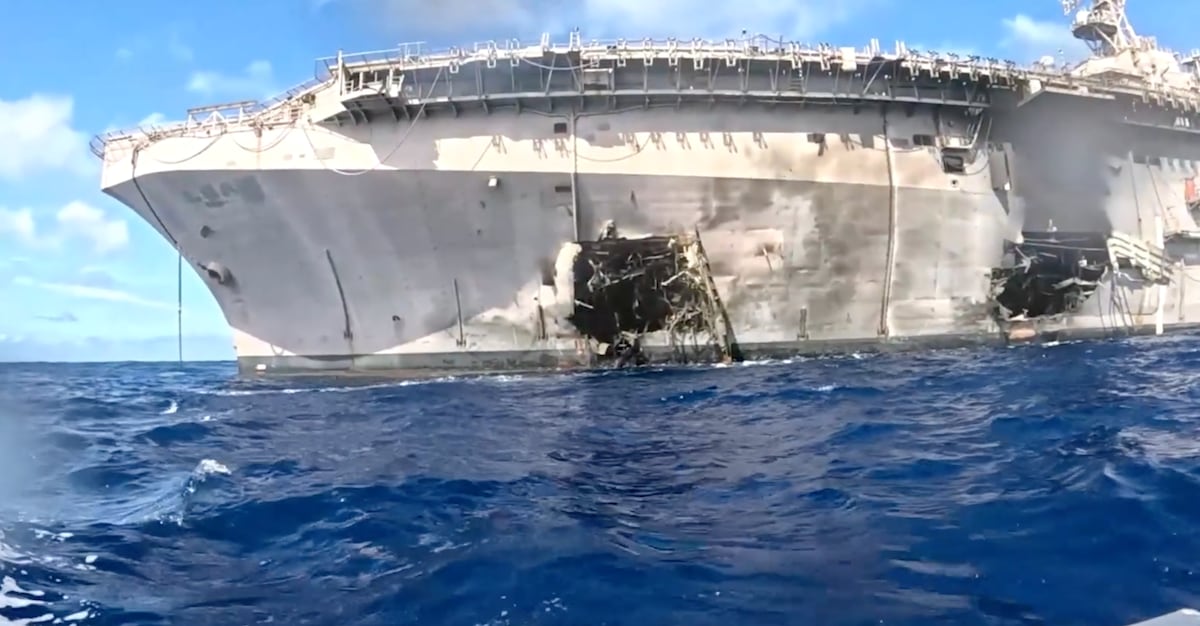
Two former U.S. warships, the amphibious assault ship USS Peleliu and the cruiser USS Mobile Bay, were sent below the seas off the coast of Hawaii during a live sinking exercise, or SINKEX, event during the biennial Rim of the Pacific exercise.
On July 24, the Navy released footage of the sinking, including the USV targeting the hulk of the USS Peleliu.
Sarah Weinstein, a surface warfare officer currently serving as the first Commanding Officer of Unmanned Surface Vessel Division 32, confirmed that her division, USVDIV-32, was behind the execution of the Navy’s first GARC live fire.
“It was incredible to watch my team execute with precision and we were thrilled to provide a perspective of the former USS Peleliu that often isn’t often captured in a SINKEX,” the officer wrote on LinkedIn.
The sinking, which took place on July 17, found the GARC at the center of the Peleliu SINKEX. Created by the Baltimore-based BlackSea Technologies, the company touts the GARC as the “most proven tactical sUSV on the water.”
With a payload capacity of up to 1,000 pound and a range of 700 nautical miles at a speed of 22 knots, BlackSea writes that the 16-foot GARC “combines modular payload flexibility, advanced autonomy, and rugged endurance.”
In addition, operators can control the vessels individually or as a swarm. It’s driven manually or given a target to follow by using radar.
In August 2025, the Navy announced that it was “experimenting with the Global Autonomous Reconnaissance Craft (GARC)” to support naval operations. And just last month, USVDIV-32 utilized the drone boats during Exercise BALTOPS 2026, one of NATO’s premier maritime exercises.
“We are at the beginning and we don’t even know where we’re going to take it yet,” Weinstein told The Wall Street Journal in June. “The GARC originally was designed to kind of do a limited skill set, and we’ve turned it into something that can do escort, that can do surveillance, intelligence, maritime domain awareness, and we’ve already with one platform been able to expand what is in the realm of possible.”
Now, with its hand in sinking the USS Peleliu, the GARC continues to surpass its testing milestones as it inches its way toward operational deployment.
Claire Barrett is an editor and military history correspondent for Military Times. She is also a World War II researcher with an unparalleled affinity for Sir Winston Churchill and Michigan football.
Read the full article here