

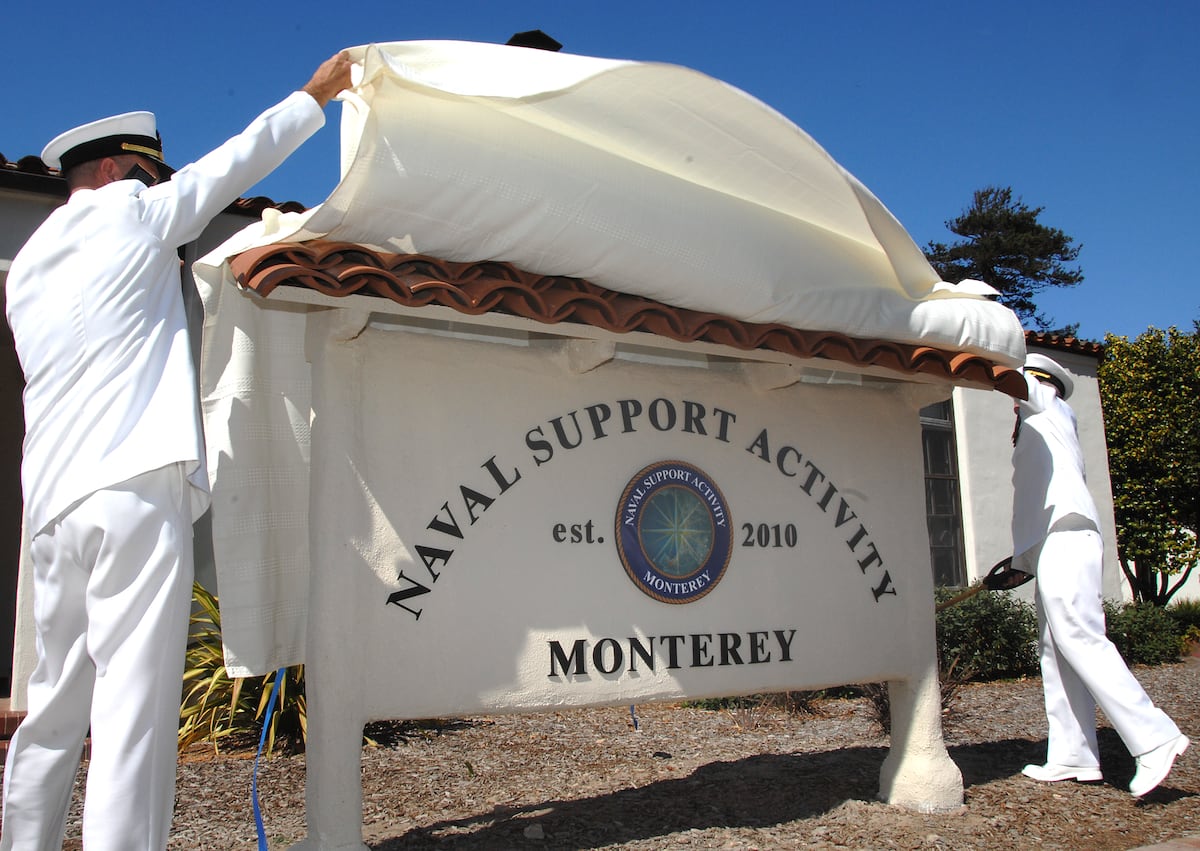
Naval Support Activity Monterey, California, is now home to the Pentagon’s most powerful supercomputer.
The base, which houses the Naval Postgraduate School, the Naval Research Lab and Fleet Numerical Meteorology and Oceanography Center, received a DGX GB300 computer — billed as the highest-performing AI processing system available for enterprises — under a cooperative research and development agreement between NPS and AI giant NVIDIA that began in December 2024.
A ribbon-cutting ceremony to launch the new system took place Wednesday afternoon with NVIDIA founder and CEO Jensen Huang and the commander of U.S. Pacific Command, Adm. Samuel Paparo in attendance.
Installed at NPS and within the school’s network, the machine will provide “a substantial increase in computational capacity to the NPS.edu network while operating within the existing power and water infrastructure of the school,” Navy officials said in a release.
The makeup of the supercomputer — which combines 36 NVIDIA Grace CPUs with 72 NVIDIA Blackwell Ultra GPUs, according to officials — enables it “to process large volumes of work in parallel rather than just sequentially,” according to the release. “This architecture is particularly well suited for large AI applications, where speed and scale are essential. It enables students and faculty to train models, analyze data, and explore complex problems that were previously out of reach.”
Capt. Michael Owen, NPS’s vice provost for warfare studies and leader of the school’s AI Task Force, said in an interview with Military Times that he sees plenty of military applications for the new machine’s computing power.
“You can think of of massive logistics-scale challenges of, how would you distribute beans, bullets and all of the standard defense logistics things — supply chain management challenges,” he said. “It could be … cybersecurity models to be able to be better positioned to understand where there are potential threats in network traffic.”
The Navy’s work — unique within the Department of Defense — in meteorology and oceanography will benefit from a computer able to create models at smaller and smaller resolutions, Owen added.
“You can get better predictability for very localized operations, as opposed to more like, 50-kilometer grids,” he said. “When you start talking about defense operations, your general weather modeling that you would see at your evening weather news or in the morning for your commute, is just not adequate. [The supercomputer] really unlocks whole new methods of, how do I even think about modeling the weather or the climate, or how do I think about solving these problems.”
While the Defense Department has its own Defense Supercomputing Resource Center, maintained by the Army Corps of Engineers in Vicksburg, Mississippi, that center is maintained for operational use, Owen said.
“What’s unique and different about NPS is that we are research and innovation-focused,” he said. “It’s not just, here’s my model — I need to run it just to operate … we are going to be focused on, how do we change the models? How do we improve the models?”
The CRADA and installment of the supercomputer started with an expressed interest from Huang, Owen said, to partner with the school and “help make NPS one of the premier AI institutions in the world, and definitely the premier U.S. defense institution or school for artificial intelligence.”
NPS announced last December that it was launching a new master’s program in artificial intelligence to provide troops from around the joint force and in allied militaries with tools to lead AI integration into warfighting. Its first cohort is underway with 11 students.
According to officials, the new supercomputer will be available to NPS students and faculty, though staff plan to “carefully manage demand,” particularly at the outset.
“While utilization is expected to grow steadily over time, the true value of this capability is not measured in compute hours alone,” officials said in the release. “It is measured by how quickly NPS students and researchers can transform data into actionable knowledge, accelerate discovery, and develop solutions to pressing operational challenges.”
Read the full article here