

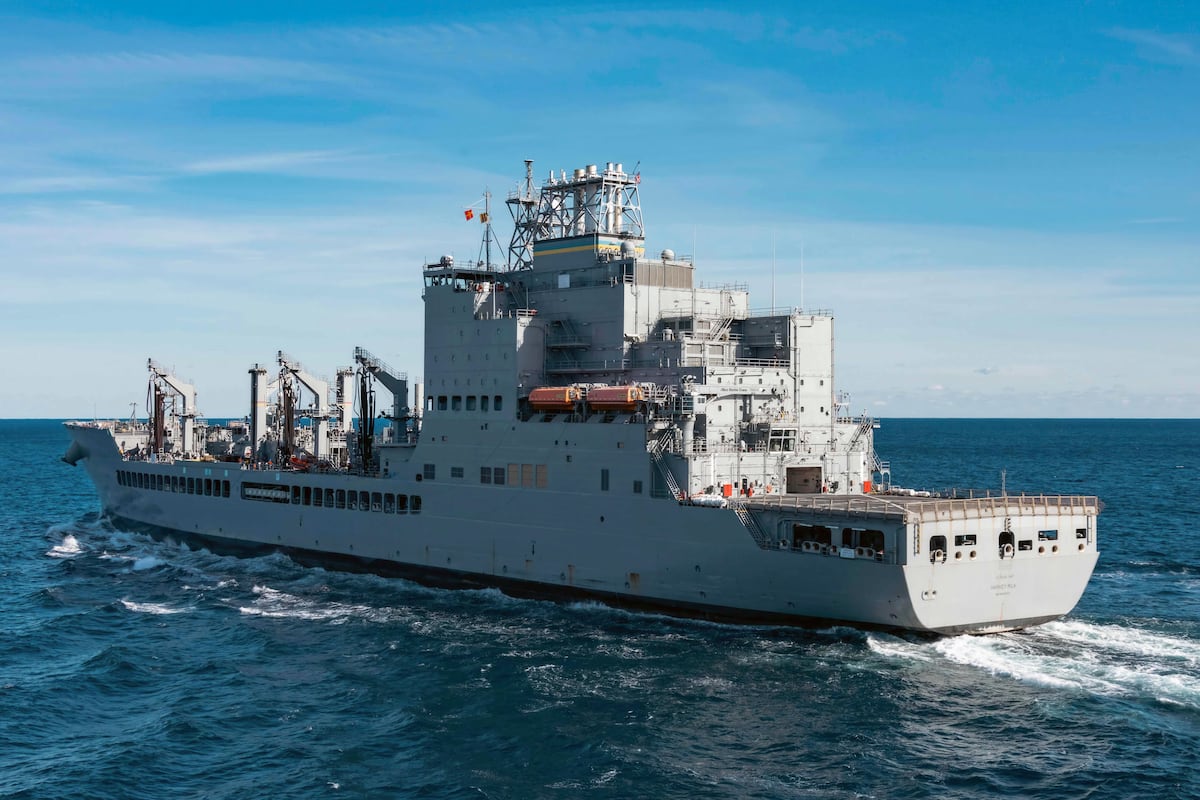
Congress is seeking to limit the authority of the Navy Secretary when it comes to changing the names of U.S. Navy vessels.
The Senate Armed Services Committee’s markup of the Fiscal Year 2027 National Defense Authorization Act includes a section that the notes that the service secretary, a position currently held by Hung Cao, may only change the name of a vessel with the consent of the Senate.
Since March 3, 1819, the responsibility of assigning names to the Navy’s ships has lied solely with the Navy secretary.
The 1819 act, according to the U.S. Naval History and Heritage Command, states that “all of the ships, of the Navy of the United States, now building, or hereafter to be built, shall be named by the Secretary of the Navy, under the direction of the President of the United States, according to the following rule, to wit: those of the first class shall be called after the States of this Union; those of the second class after the rivers; and those of the third class after the principal cities and towns; taking care that no two vessels of the navy shall bear the same name.”
The Senate committee seeks to add a provision that would amend section 8662 of Title 10 “to require that only Senate-confirmed Secretaries of the Navy may rename a vessel and only if justified with a notification to the Congress 30 days before such a vessel is renamed.”
The provision comes roughly a year after Defense Secretary Pete Hegseth renamed the USNS Harvey Milk — named in 2016 after the slain gay rights activist and Navy veteran — to the USNS Oscar V. Peterson, a Medal of Honor recipient who was killed during the Battle of the Coral Sea during World War II.
One amendment that did make it through into the House’s version of the FY2027 NDAA was a call to consider naming future Navy vessels after two historically significant naval battles: Midway and Guadalcanal.
A third amendment, proposed by Rep. Austin Scott, R-Ga., put forth the potential name of USS Casimir Pulaski “to honor the Revolutionary War hero and recognize the strategic partnership and alliance between the United States and Poland.”
The provisions, according to Scott, will enable the continued recognition of the historically significant naval battles and promote “esprit de corps, preserv[e] institutional memory, and strengthe[n] the connection between the Fleet and the Nation’s naval heritage.”
Claire Barrett is an editor and military history correspondent for Military Times. She is also a World War II researcher with an unparalleled affinity for Sir Winston Churchill and Michigan football.
Read the full article here