

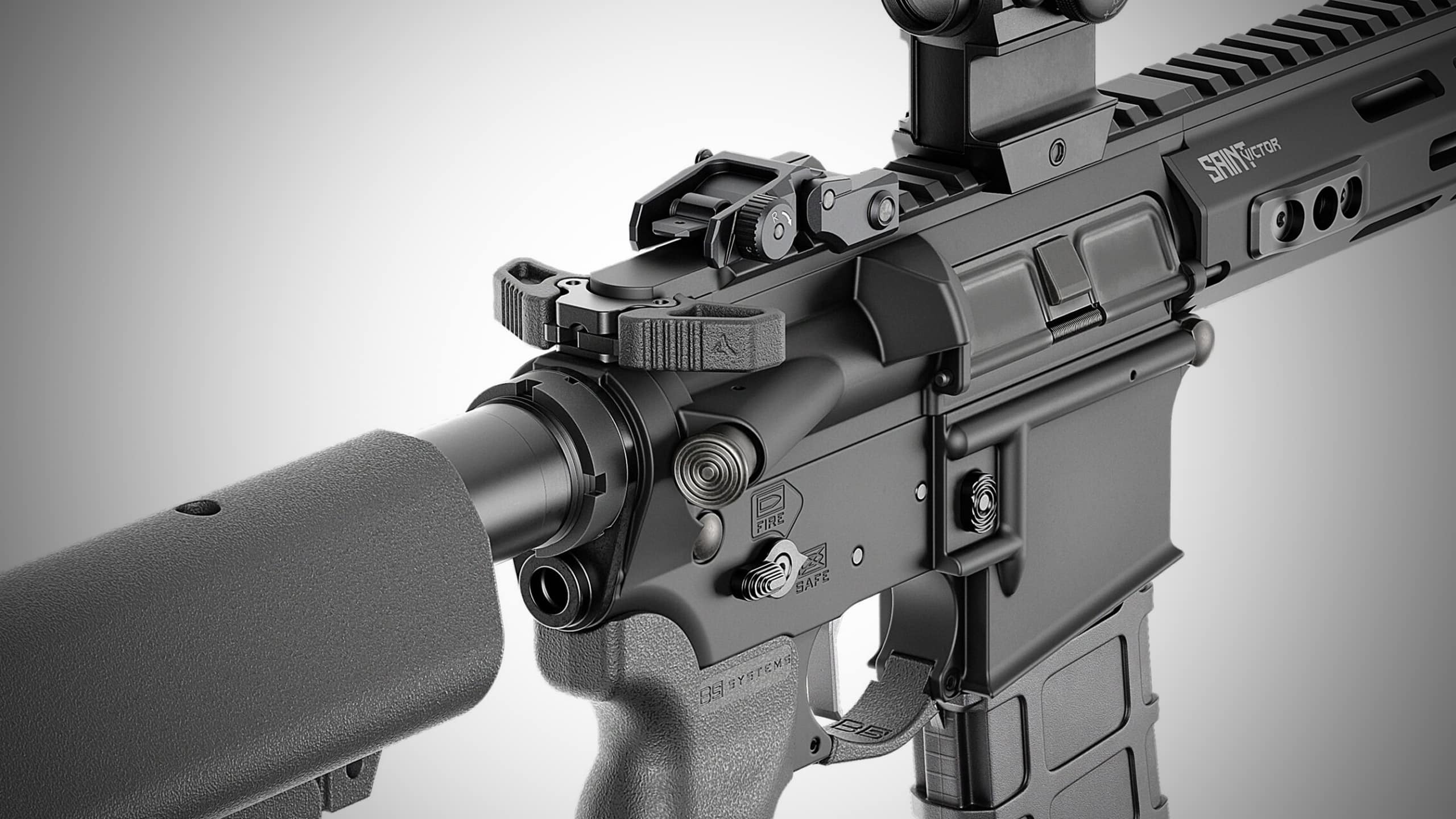
You might be wondering why Springfield Armory chose to equip the latest generation of SAINT Victor AR-15 rifles and pistols with Radian Raptor-LT charging handles. While it won’t help you to shoot tiny groups, it excels is all that necessary procedural stuff that’s done to ready the rifle to fire (or ensure it keeps running).
The Raptor-LT is smooth to operate, making loading faster, and when it happens — and we all know it can if you run across some bad ammo — the charging handle will literally get you out of a jam.
What Does a Charging Handle Do?
There are three things a charging handle allows you to do: chamber a cartridge, perform a press check and clear malfunctions. An AR-15 charging handle’s job is to manually operate the bolt carrier group (BCG) so it can cock the hammer, strip a round out of the magazine and drive a cartridge in the chamber. A charging handle’s basic function is to ready the rifle to fire.

The design of the Radian Raptor-LT changes the ergonomics of this part to allow the user to more easily, more quickly and more smoothly manipulate the action. A standard mil-spec charging handle gets the job done, but there are better options like the Radian Raptor-LT that can help you to load better, perform smoother press checks, and more easily clear malfunctions.
Mil-Spec vs. Oversized Charging Handle
Mil-spec charging handles are small and have rounded handles. The design is intentional. The rounded handles won’t snag on gear or in a tight environment, and the rounded edges allow the charging to easily slip from your fingers when you are releasing it. The problem is that a mil-spec charging handle may slip from your fingers too soon before a round is loaded. And, because it is small, it can be harder to manipulate while wearing gloves. If you use certain charging handle techniques, you know that mil-spec charging handles don’t like lateral movement and can bind.

Oversized charging handles reduce the possibility of your hand slipping from it during charging. The handles are larger so there is more surface area to grasp. The Raptor-LT wears serrations on the front and back of the handle, so whatever charging technique you use you have traction even if you are wearing gloves.

Live The Armory Life. The latest content straight to your inbox plus an automatic entry to each of our monthly gun giveaways!
The shaft of the Raptor is hardened and slick, so it slides even when you might apply too much lateral movement. What’s nice about the Raptor-LT is that the handles are made of high-strength, fiberglass reinforced polymer so there is no excess weight added to your rifle — even though they are oversized.
Blade, Hook, Fangs, Pinch
There are four ways to use an AR-15 charging handle when using your support hand. The first is Blade. This is when the top edge of the support hand catches on the charging handle to rack it back. The second method is the Hook, where the support hand index finger grabs the charging handle to rack it back. Fang or Double Hook method is when the first two fingers of the support hand each grasp a handle to pull back. The Pinch method is when the index finger and thumb pinch one side of the handle to pull it back.

With all methods, the oversized handles of the Raptor-LT and serrations make the charging handle easy to grasp and manipulate. I noticed right away that the shaft on the Raptor was super slick. Performing all methods with and without gloves provided the confidence that when I performed a fast load, I wouldn’t short stroke the charging handle nor was I afraid I would bend the handle if I manipulated too roughly.

If you are left-handed, you know mil-spec charging handles favor right-handed shooters. The Raptor-LT is agnostic when in comes to right or lifted handed shooters.
Optic Considerations
With a red dot mounted on an AR-15, the position of the optic is well clear of the charging handle. Add a low power variable optic (LPVO) or any riflescope, and the dynamics between the charging handle and optic change. Many times, the eyepiece of the scope rests just above the charging handle. Some optics, like thermal scopes with rubber eyepieces, are extended even farther back and the optic is usually chunkier than a typical rifle scope. Add a magnifier to a red dot and you have the same issue of less access to the charging handle.

When using a mil-spec charging handle, I have found I need to work around the optic to manipulate it and be efficient. Add gloves to the mix and it can be a tight squeeze. Heavy winters gloves make manipulating the charging even more of a challenge.
To address these concerns, the Radian Raptor-LT has ambidextrous, oversized handles. It really doesn’t matter where you mount the optic or its footprint and size. The handles protrude far enough away from the upper receiver and eyepiece to offer a good grasp without sticking out too much and hanging up on gear.

I mounted a red dot on the new SAINT Victor and swapped it out for an LPVO. The Radian Raptor-LT offered easy manipulation sitting at a bench, lying prone or standing. Performing a press check takes less effort, too.
Getting Out of a Jam
If things go sideways and your AR-15 malfunctions, an oversized charging handle like the Raptor-LT provides added leverage to rip back the bolt to eject a stuck cartridge. The jam could be a failure-to-feed, failure-to-eject, failure-to-fire, double-feed or other jam that defies logic.

In any of these potential malfunction scenarios you need to manipulate the charging handle. Clearing a AR-15 jam fast and efficiently means you are back in the game with minimal down time. If things are really jammed up and you need to “mortar” your AR, oversized handles are a real asset. A good oversized charging handle will get you back up and running fast.
Conclusion
The charging handle is used every time you fire an AR-15. It may not be the first enhancement you think of for an AR, but it is totally practical and enhances performance. The ambidextrous Radian Raptor-LT helps to improve ergonomics and is a big step-up from a mil-spec charging handle. Bigger is better in this situation. The Raptor-LT is a practical performance enhancement to the SAINT Victor line of rifles and pistols.
Editor’s Note: Please be sure to check out The Armory Life Forum, where you can comment about our daily articles, as well as just talk guns and gear. Click the “Go To Forum Thread” link below to jump in and discuss this article and much more!
Join the Discussion
Featured in this article


Read the full article here