

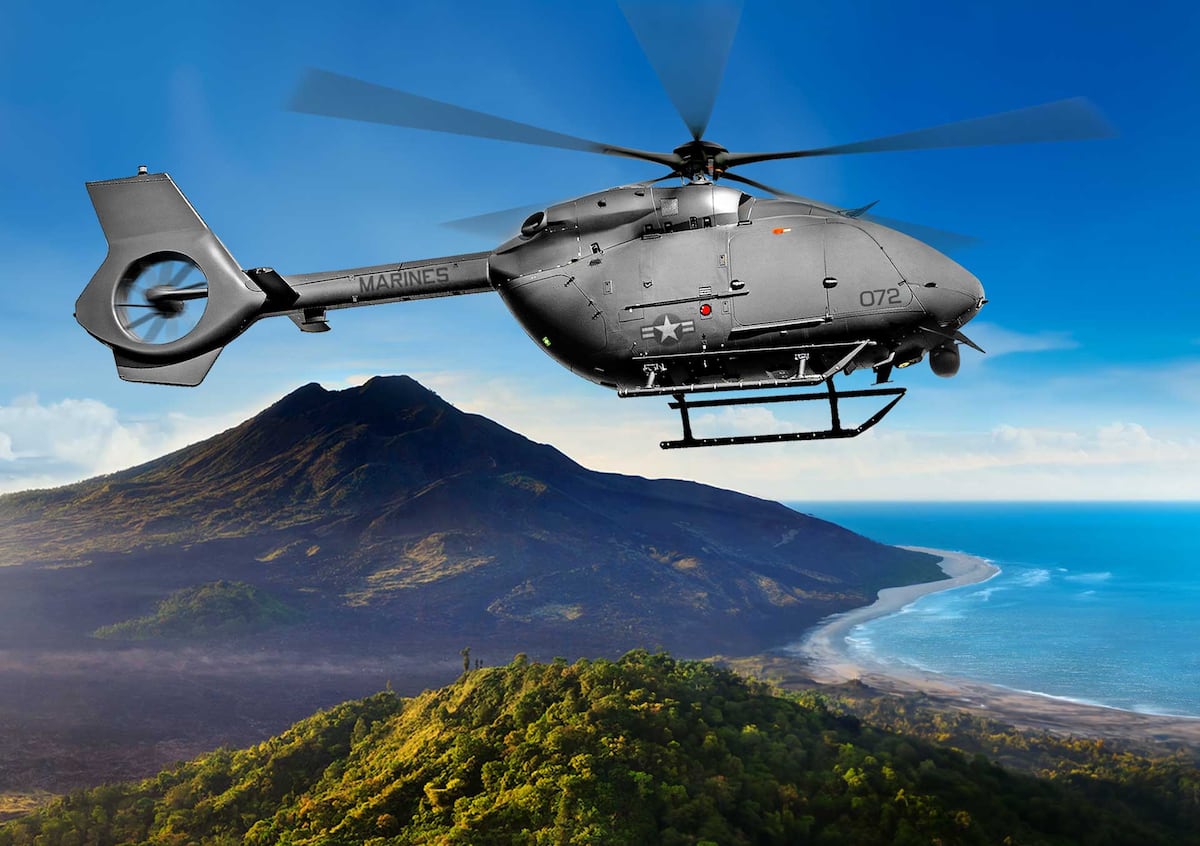
The biggest of the aircraft planned for the Marines’ arsenal of unmanned flying logistics trucks is expected to be put through its paces at one of the Corps’ littoral regiments in the Pacific next year, officials said Tuesday.
The service is “aggressively pursuing” an operational demo in 2027 for the Aerial Logistics Connector, or ALC, said Lt. Col. Ben Link, head of vertical takeoff and landing concepts for the Marines’ Cunningham Group, an aviation-focused innovation unit.
“We will fight with prototypes and rapidly learn and refine our requirements,” Link told an audience at the Modern Day Marine exposition in Washington, D.C. “ALC’s mission is clear and critical — to provide autonomous airborne logistics to sustain the stand-in force. ALC is a key component to all-domain logistics, which enables [the Department of Defense], ensuring our distributed units remain supplied, lethal and combat-ready.”
Last June, Airbus and the Alexandria, Va.-based Parry Labs announced a partnership to develop a drone version of the UH-72 Lakota helicopter for the ALC program. This month, the team, working alongside L3Harris Technologies and Shield AI, announced the aircraft’s fourth autonomous flight test, also saying they demonstrated the relevant technologies aboard an Airbus H-145 Multi-Role Light-Twin helicopter, “executing autonomous flight while avoiding obstacles and safely landing in conditions that mirror real-world environments.”
Near Earth Autonomy is also working on ALC, conducting an autonomous test flight last year on a Leonardo AW139 helicopter.
ALC is not to be confused with Medium Aerial Resupply Vehicle — Expeditionary Logistics (MARV-EL), a similarly sized autonomous logistics chopper. This month, Near Earth and Lockheed Martin received separate prototyping contracts or MARV-EL.
In fact, the Marine Corps is likely still tinkering with its concepts for the aircraft.
“They’re very complimentary, very similar requirements, but we’re taking a deep look at where we are today and where that system needs to go,” Link said. “As it stands today, MARV-EL is designed to be an organic logistics air vehicle owned and operated by the ground force. ALC is general support to the [Marine Air-Ground Task Force], owned and operated by the aviation side.”
Nonetheless, the plan to push ALC out to one of the Marine Littoral Regiments in the Pacific for tinkering shows a growing interest in using these units for testing, experimentation and concept development. In 2025, leaders of the Okinawa-based 12th MLR hailed the utility of the autonomous low-profile vessel (ALPV), a logistics platform based on a narco-sub that was sent to them for testing. In planning guidance released last October, Marine Corps Commandant Gen. Eric Smith announced that the semi-submersibles would be transitioning to a program of record for the Corps based on their trial period in the Pacific.
RELATED
Link said the Corps wanted both of the prime vendors for ALC to provide a flying prototype for the demo.
“Very likely, they will not be completely autonomous aircraft, as we envision to achieve by the end of the middle tier of acquisition,” he said, adding the service was now two years into a five-year acquisition program. “What we’re looking to pull is two aircraft at a minimum, one from each vendor, that’s optionally piloted, so we can run a full mission autonomy experiment with our MLR OCONUS and really put it in [the Marines’] hands … so we really are looking to learn a lot from their perspective on what they need, as one of the use cases for ALC.”
As the Marines illustrated in a Venn diagram chart at the conference, the service is developing ALC, its large autonomous logistics platform, alongside four other autonomous aircraft projects: MUX-TACAIR, a collaborative combat aircraft designed to fly alongside manned fighters; Future Attack Strike (FASt), an attack platform that may be optionally piloted and will also be optimized for manned-unmanned teaming; MUX-MALE, the Corps’ MQ-9 Reaper program for intelligence, surveillance and reconnaissance; and Organic ISR, a future Group 3 UAS that will “provide persistent overhead coverage for Marines on the ground, in addition to executing whatever missions that the [aviation combat element] requires to remain relevant in the future,” Link said.
If that’s confusing now, it’s likely to become only more so in coming years.
“Fast forward a few years, and you look at emerging capabilities, and the lines start to blur,” said Maj. Michael Zbonack, a planner with Future Concepts UAS. ” … The end result that we’re driving for is a high-low mix of a family of systems delivering a wide range of capabilities to support the MAGTF.”
Read the full article here